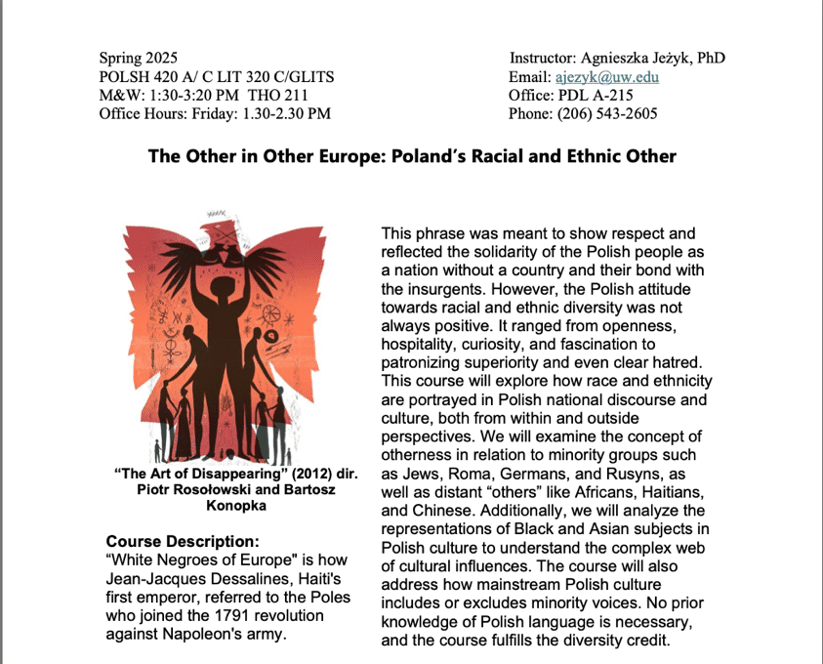
On March 31, 2026, a group of scholars gathered virtually for an engaging Zoom roundtable on innovative approaches to teaching Polish studies and Polish history. This teaching roundtable was an event planned to set the stage for the upcoming announcement of the Polish Studies Association’s 2026 Syllabus Award Competition. The award for this 2026 competition, which carries a $500 stipend, will honor the syllabus that showcases the most innovative approach to teaching Polish studies within transnational and global contexts. Held every other year, this competition furthers a core goal of the PSA, namely the recognition and dissemination of novel methods for teaching Polish studies. Several of the presenters at the March 31st teaching roundtable participated in the 2024 iteration of the PSA’s Syllabus Award competition, which Agnieszka Jeżyk, the Maria Kott Endowed Assistant Professor of Polish Studies at the University of Washington, won for a course entitled “The Other in Other Europe: Poland’s Racial and Ethnic Other.” The other submissions for the 2024 competition are published at this site.
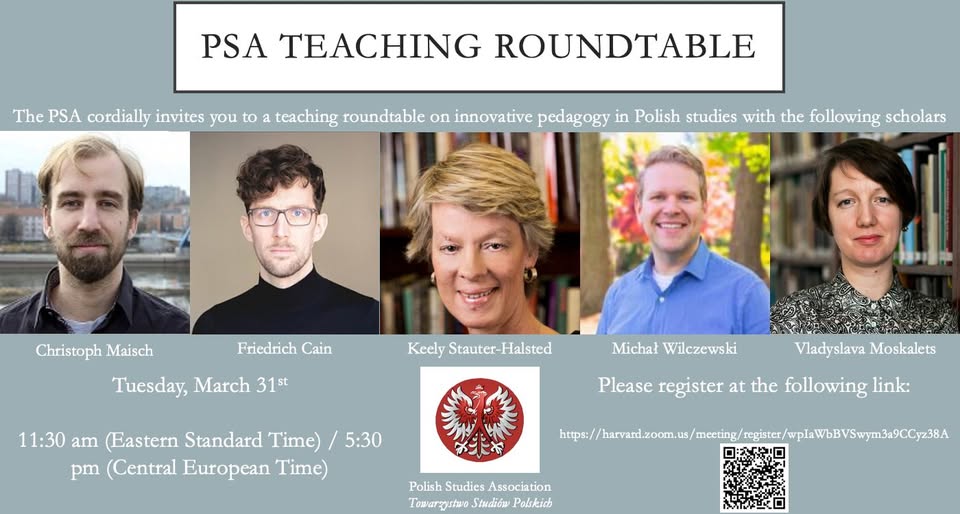
Five scholars with innovative approaches to teaching Polish studies spoke at the March 31st roundtable about some of their recently offered courses. Most striking was their shared aim: to elevate perspectives from Polish history that were once viewed as marginal to the centerpiece of their courses. Whether focusing on borderland regions like Galicia, incorporating the voices of ethnoreligious minorities in Poland into their curriculum, or centering around questions of gender and sexuality, all of the courses revealed novel approaches to teaching Polish studies that broke with more traditional molds.
Friedrich Cain and Christoph Maisch began the roundtable by relating their experiences teaching a joint research seminar entitled “Transregionality and Transculturality in Historical Galicia and Ukraine” that ran during the summer of 2023. Cain serves as a postdoctoral assistant at the University of Vienna’s Chair of Historical Transregional Studies, while Maisch, a postdoctoral researcher and science manager, specializes in interdisciplinary Central and Eastern European Studies. As Cain underscored in his opening remarks, “Transregionality and Transculturality in Historical Galicia” brought together student participants at the undergraduate and graduate level who hailed from four different countries—Germany, Austria, Poland, and Ukraine—and a wide set of disciplinary backgrounds. Cain and Maisch belonged to a strikingly transnational, multilingual, and interdisciplinary set of instructors for the course that also included Monika Janicka of Maria Curie-Skłodowska University, Wiera Meniok of the Drohobych State Pedagogical University of Ivan Franko, and Lothar Quinkenstein of Adam Mickiewicz University.
At the course’s intellectual core, as Maisch articulated in his remarks, lay a basic question: what happens when one stops treating a region like Galicia as a stable entity and instead approaches it as a site of competing national narratives? Foregrounding Galicia as a contested, multiperspectival space, the course thus sought to deconstruct the national frameworks through which the region’s history and culture have often been studied in favor of a focus on cultural entanglement. One could imagine “Transregionality and Transculturality in Historical Galicia and Ukraine” serving as a model for designing courses on other contested borderland regions in Central and Eastern Europe, such as Silesia or Bohemia.
Given its geographically dispersed participant base, this 2023 course proceeded in a hybrid format. All students completed a combined online preparation for the in-person research seminar, which eventually took place during an intensive week in Lublin. Due to the ongoing full-scale Russian invasion of Ukraine, the course participants were unfortunately unable to meet in the heart of historic Galicia but settled on Lublin as an adequate substitute. During their meetings in Lublin, the students engaged in wide-ranging discussions about historical imaginaries of Galicia while also undertaking various excursions, including to the Nazi concentration and extermination camp of Majdanek. Following their return to their home institutions, the students recorded final audio or video podcasts in which they cogitated on their experiences in the seminar.
As Cain and Maisch both underscored, the course’s primary merit was also its principal challenge, as the promise of transnational scholarly engagement simultaneously presented significant difficulties of coordination and funding challenges. Nonetheless, both speakers clearly stressed that the benefits of cross-border cooperation and transnational academic discussion outweighed any logistical challenges. Galicia’s rich multicultural heritage was mirrored by the lively, productive conversations that transpired between students from Drohobych, Frankfurt (Oder), Poznań, and Vienna in Lublin during the summer of 2023.
Keely Stauter-Halsted followed Cain and Maisch’s remarks with a presentation on a course entitled “The Making of Modern Poland,” her recurring introductory lecture class at the University of Illinois Chicago (UIC) that she again offered during the spring of 2026. Stauter-Halsted, Professor and Stefan and Lucy Hejna Family Chair in the History of Poland at UIC, identified parallels between her own course and the one on which Cain and Maisch had just presented. Indeed, Stauter-Halsted highlighted that her course fundamentally aimed to challenge traditional notions of Polish identity that its students might initially hold—especially the notion of an immutable, age-old Polish-Catholic synthesis—by stressing the central role of ethnic minorities and religious diversity in the country’s history. Just as Cain and Maisch’s course aimed to destabilize nationalist conceptions of Galician history, Stauter-Halsted’s course thus emphasized the variable meanings of Polishness over time. Challenging students to engage with edgy, complicated questions lay at the heart of “The Making of Modern Poland.” The role of Mieszko I in the slave trade, antisemitism in Poland, collaboration with occupying forces during the Second World War, and resistance during the Communist period were but some of the weighty themes that Stauter-Halsted encouraged students in the course to ponder and discuss.
As an introductory course whose students often arrive with only limited experience in History classes, especially those concerning Polish topics, “The Making of Modern Poland” is targeted toward a different set of students than the more specialized course on the history of Galicia that Cain and Maisch helped to organize. Nonetheless, its ambit is wide-ranging, with the readings, lectures, and assignments in the course exposing its students to a stimulating set of pressing historical questions. Stauter-Halsted covers over ten centuries of Polish history in the course while also devoting time during each class for students to discuss contemporary issues in Poland with an eye toward their historical geneses. Moreover, the assignments that Stauter-Halsted designed for the latest iteration of the course in 2026 ranged from more traditional papers to a required presentation on a famous Pole of each student’s choosing. “The Making of Modern Poland” therefore represents a departure from standard lecture courses on Polish history by encouraging students to question traditional understandings of Polishness, to consistently reflect on connections between past and present in the country, to pursue their own specific areas of interest in certain individual assignments, and to develop their critical reasoning abilities in frequent discussions about complex historical topics. Stauter-Halsted’s presentation articulated a compelling blueprint for how to design a systematic and innovative introductory lecture course in Polish history, one that blends classic texts with newer materials and mixes traditional papers with creative assignments.
Michał Wilczewski, Associate Professor of Instruction in the Department of Slavic Languages and Literatures at Northwestern University, continued the roundtable presentations with a dive into three courses in Polish studies and East-Central European history that he has recently taught. Incidentally, Wilczewski is Stauter-Halsted’s former dissertation advisee and served as a teaching assistant in “The Making of Modern Poland” for several semesters at UIC.
Three courses, “Sex in the Slavic World,” “Sin, Skin, and Spectacle: Sexuality in East Central Europe,” and “Queer Lives in East-Central Europe” were the focus of Wilczewski’s presentation. While “Sex in the Slavic World” is a first-year seminar in which Wilczewski also introduces freshman students to college-level writing and discussion, “Sin, Skin, and Spectacle” and “Queer Lives in East-Central Europe” are geared toward upper-level students. Owing to, as Wilczewski put it, a contemporary explosion of literature on gender and sexuality in Polish historiography, his courses draw significantly on newer works in the field of Polish studies. Wilczewski argued that recent innovations in Polish historiography have thus broadened his pedagogical possibilities, enabling instructors such as himself to draw on more substantial bodies of literature and more developed intellectual frameworks in designing such courses.
Many students…often initially found the material difficult to digest because it so thoroughly challenged many of their foundational notions.
Normalizing the study of gender and sexuality in Polish history and facilitating the unlearning of common stereotypes and conceptions about Poland and East-Central Europe constituted a shared goal for Wilczewski across all three of these courses. Invoking Stauter-Halsted’s “The Making of Modern Poland” course at UIC, Wilczewski contended that many students in his courses often initially found the material difficult to digest because it so thoroughly challenged many of their foundational notions about East-Central Europe as a culturally conservative, even “backward” region. Indeed, Wilczewski noted that students were often, for instance, surprised to learn that several countries in East-Central Europe decriminalized homosexuality well before many of those in the west. Instead of merely presenting the study of gender and sexuality in modern Poland as a clash between cultural progressivism and conservative panic, Wilczewski’s courses take a different approach, such as foregrounding the study of everyday life through the lens of desire. Discussions about gender and sexuality, Wilczewski’s courses seek to highlight, lay at the heart of foundational contestations over the contours and meanings of Polishness and East-Central European politics in the modern world. Topics once deemed marginal and peripheral by historians are, as Wilczewski’s course designs elucidate, critical to understanding modern Polish identity. Indeed, they can serve as the central lens through which to study modern Poland and to structure a rich, engaging college course.
Vladyslava Moskalets, a researcher at the Center for Urban History of East-Central Europe in Lviv as well as an Associate Professor at the Department of History and Coordinator of the Jewish Studies Program at the Ukrainian Catholic University in Lviv, concluded the roundtable presentations with an introduction to a course that she co-taught during the spring/summer term of 2024. Along with Kornelia Kończal and Yaroslav Zhuravlov of Bielefeld University, Moskalets co-instructed a course entitled “Entangled Borderland: History and Memory of Habsburg Galicia in the Long 19th Century and Beyond” that was open to both undergraduate and graduate students from a wide range of disciplinary backgrounds, among them History and Philology. Consequently, Moskalets noted that many students who enrolled in the course initially did so for a variety of reasons, with some wishing to learn more about Jewish life in Galicia, others about the region’s place in the Polish popular imaginary, and others because of its place in Ukrainian history. Much like the aforementioned course on Galicia, “Entangled Borderland” benefitted from this mix of interests and perspectives among its student participants. Moskalets’ presentation also highlighted how deeply academic interdisciplinarity furthered the aims of the course organizers to foster wide-ranging, intercultural discussions among their students.
As Moskalets explained, this course was a blended seminar that included both an online component and on-site research trips to Ukrainian Greek Catholic religious sites and the Galiziendeutsches Archiv (at the Martin-Opitz-Bibliothek in Herne) in the German federal state of North-Rhine Westphalia, although only the student participants at Bielefeld University were ultimately able to participate in the latter excursions. Each online session was organized around a central theme—among them, “Galicia? Galicia(s)!,” “Religion,” “Migration,” “Violence,” and “Galicia’s afterlife in Austria, Poland, Ukraine and in Jewish communities”—with accompanying discussion questions to prime the conversation among the student participants. As its title suggests, this course foregrounded cultural entanglement in Galicia, rather than merely viewing the region as the site of conflict between warring nationalist factions. The course’s thematic organization, Moskalets suggested, forced students to reckon with the impact that changing forms of political control in Galicia exercised on notions of collective belonging in the region and to challenge common misconceptions or stereotypes about the region’s place in Eastern Europe. Much like Cain and Maisch, Moskalets stressed the beneficial impact of interdisciplinarity and transnational cooperation on the learning outcomes in this course, which brought together students from numerous countries and academic backgrounds.
The question-and-answer portion of the roundtable developed into an engaging discussion about pedagogical approaches and course design strategies. Christoph Maisch, Friedrich Cain, and Vladyslava Moskalets spoke at greater length about designing transnational courses with students who possessed different language skills, revealing that they often combined certain shared materials available to students in languages in which they were proficient, like English, while offering course participants some choice in selecting supplementary readings. Stauter-Halsted and Wilczewski highlighted the occasional difficulty of finding sufficient primary source materials in English for general courses on Polish history at their American universities, while also noting that their introductory lecture courses sometimes inspired students to begin learning Polish or to deepen their existing language skills.
Thereafter, the participants spoke about how most effectively to select class materials and design assignments in Polish studies courses in the current digital age. Maisch and Cain noted that the students in their course responded very positively and creatively toward the class’s final assignment, in which they were tasked with producing their own podcasts instead of writing a final paper. Stauter-Halsted found that students at UIC engaged particularly strongly with discussions and assignments in which they were tasked with adjudicating points of contention between different course materials, especially those with edgier bents. She even incorporated small competitions, like extra point awards for the most effective student essay titles, and creative exercises, like a map drawing exercise of the Polish Second Republic, into her course design strategy. Wilczewski highlighted the effectiveness of periodic small-group work within larger seminars, noting that students often held each other accountable and developed stronger confidence with the material in those settings. Citing a technique implemented by her co-instructor Kornelia Kończal, Moskalets elucidated a strategy that worked well in the course on Galician history about which she presented; at the end of each course meeting, every student was required to distill their main learning takeaway into a one-sentence summary.
The last part of the roundtable discussion turned toward future course design plans. Wilczewski noted that he wished to fine-tune an envisioned course on everyday life in modern Poland but was still working to find adequate materials in English for such a class, especially on the period before the nineteenth and twentieth centuries. Moskalets was especially interested in incorporating architectural study and visits to historic sites in Galicia into her future courses in Lviv. Cain and Maisch highlighted an interest in future collaborative, transnational courses but also noted that they needed to work out certain funding challenges and issues with cross-university coordination. Maisch also expressed a desire to once again attend the Bruno Schulz festival in Drohobych with future students, which he has not been able to do since the full-scale Russian invasion of Ukraine commenced in 2022. All of the speakers at the roundtable expressed a desire to further exchange pedagogical techniques with their co-participants.
The productive exchange of ideas that emerged during the roundtable discussions pointed toward the fruitfulness of organizing regular teaching events in the future. New syllabi and innovative pedagogical techniques are often shared among academics at a much lower rate than published scholarly works, so teaching roundtables can serve as a crucial forum for discussions about instruction and course design. As the participants in the roundtable also underscored, their experiences teaching these courses complemented their own research pursuits and conceptualization of pertinent historiography. More broadly, teaching roundtables can play a crucial role in stimulating dialogue about shifting scholarly frameworks of analysis, the absorption of newer academic literature into various disciplinary fields, and the structuring of productive intellectual debate.
Nikolas Weyland is a History PhD candidate at Harvard University. His dissertation investigates the sociopolitical activities of Polish-speaking migrants and their descendants in the German Ruhr region between the late-nineteenth and mid-twentieth centuries while especially focusing on the treatment of these “Ruhrpolen” by German state officials, companies, and sociologists.