ASEEES thanks Douglas Rogers (Yale University) for chairing the prize committee and formulating the interview questions.
What were the origins of this project? Did its ambitions change as you worked on it?
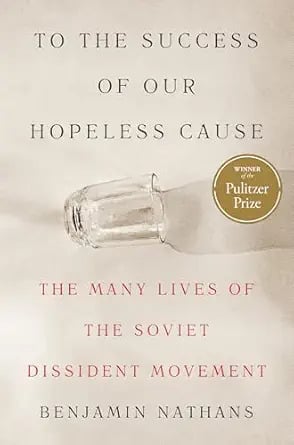
I am interested in how people in authoritarian countries construe their options for political engagement and, in some cases, act on them. Early in my career, I’d been asked to teach a survey of Soviet history, and whenever I take on a new teaching topic, I look for autobiographies by people who lived in the assigned time and place. I was amazed at how many Soviet dissidents had written book-length memoirs (over 150 by my count). The more I read, the more I began to see creative ways to address my original interest. I was initially wary of getting trapped in the echo-chamber of the memoir literature. I didn’t want to simply reproduce the dissident narrative; what I had in mind was a monograph that probed the shifting structural possibilities of dissent in the post-Stalin era and the paths by which the movement found its way to the non-self-evident doctrine of universal human rights. Eventually, however, my ambitions shifted to writing a book that might conceivably appeal not just to scholars and students but to that mythical creature known as “the educated lay reader.” I was eager to highlight the movement’s “many lives” – the human beings at the heart of the story – without compromising close textual and historical analysis.
What new understandings of the Soviet dissident movement does To the Success of our Hopeless Cause offer?
It offers a surprising origin story, tied to mid-20th-century cybernetics and ideal language philosophy. It uncovers some of the inner fault lines within the movement, between those who favored spontaneous, conscience-driven protest and others who insisted that the movement have leaders, a formal division of labor, and an organizational structure. It reveals that, for all their emphasis on promoting the rule of law and strict judicial procedure, the dissidents themselves had a deeply informal way of conducting their business and in general were allergic to rules. It also tries to recover the thinking and practices of the lesser-known or unknown figures who actually created and periodically reinvented the movement – quite a few of whom were women.
I didn’t want to simply reproduce the dissident narrative; what I had in mind was a monograph that probed the shifting structural possibilities of dissent in the post-Stalin era and the paths by which the movement found its way to the non-self-evident doctrine of universal human rights.
Historians are not always able to talk with some of their research subjects, or their friends and family. How did you integrate this element of your research into historians’ more traditional methods?
I was trained in “traditional methods” focused on written sources, whether archival or published. I was also accustomed, in my earlier work on the tsarist era of Russia’s history, to my protagonists being good and dead. So it was thrilling but also unnerving to be able to speak with former Soviet dissidents such as Alexander Volpin, Yelena Bonner, Pavel Litvinov, and Ludmilla Alexeyeva. These were, almost by definition, extraordinary people. I’m sure it would have been better to have had some formal training in oral history (I had none), but in the end I settled on a technique that rarely failed: showing up to interviews with copies of documents written by the interviewee, whether a diary excerpt, a personal letter, or a piece of samizdat – and asking them to describe the context of its composition. That sparked some wonderful conversations as well as some unsettling ones. For example, when the person insisted on reinterpreting their own words in ways that, to my mind, reflected hindsight (including the collapse of the country in which they dissented) more than “real-time” perceptions and assumptions. In one interview, Volpin announced that the diary entry I showed him (from 1959) was unfinished and that he would now finish it (a half-century later) on the spot. What?!

Does your book offer insights into dissident movements in times and places other than the Soviet Union?
I think so. For starters, I see close parallels with dissident movements in other Soviet-style societies, whether in Eastern Europe, China, or elsewhere. The shared emphasis on legalism, non-violence, and DIY techniques of free expression, not to mention the preponderance of intellectuals in these movements, all suggest that, like most orthodoxies, Marxism-Leninism gave rise to its own specific heresies. In the epilogue of my book, I also compare the Soviet dissident movement to the resistance in Nazi Germany and the American civil rights movement in the 1960s. In these cases, it seems to me, the contrasts are most illuminating. None of the various resistance groups in Hitler’s Germany invoked Nazi law. American civil rights activists used the technique of civil disobedience – deliberately violating legal forms of segregation in the Jim Crow South in an attempt to highlight the injustice of such laws – whereas Soviet dissidents engaged in what I call “radical civil obedience,” exercising civil liberties enshrined in the Soviet Constitution in an effort to persuade the Soviet government to similarly abide by its own laws.
What are you working on now?
I’ve spent much of my career writing short essays and long books. I’d like to see whether I’m capable of writing a short book.

Benjamin Nathans is the Alan Charles Kors Endowed Term Professor of History at the University of Pennsylvania, where he directs the Integrated Studies Program. He has written or edited five books, including Beyond the Pale: The Jewish Encounter with Late Imperial Russia, which was awarded the Vucinich Prize, the Lincoln Prize, and the Koret Jewish Book Award. Nathans chaired an international committee of scholars hired by Ralph Appelbaum Associates, the New York-based museum design firm, to help create the Jewish Museum in Moscow, which opened in 2012. In addition to the Vucinich Prize, To the Success of Our Hopeless Cause: The Many Lives of the Soviet Dissident Movement (Princeton University Press, 2024) was awarded the Reginald Zelnik Prize, the Pushkin House Book Prize, and the Pulitzer Prize for General Nonfiction. Nathans contributes regularly to the New York Review of Books and the Times Literary Supplement.