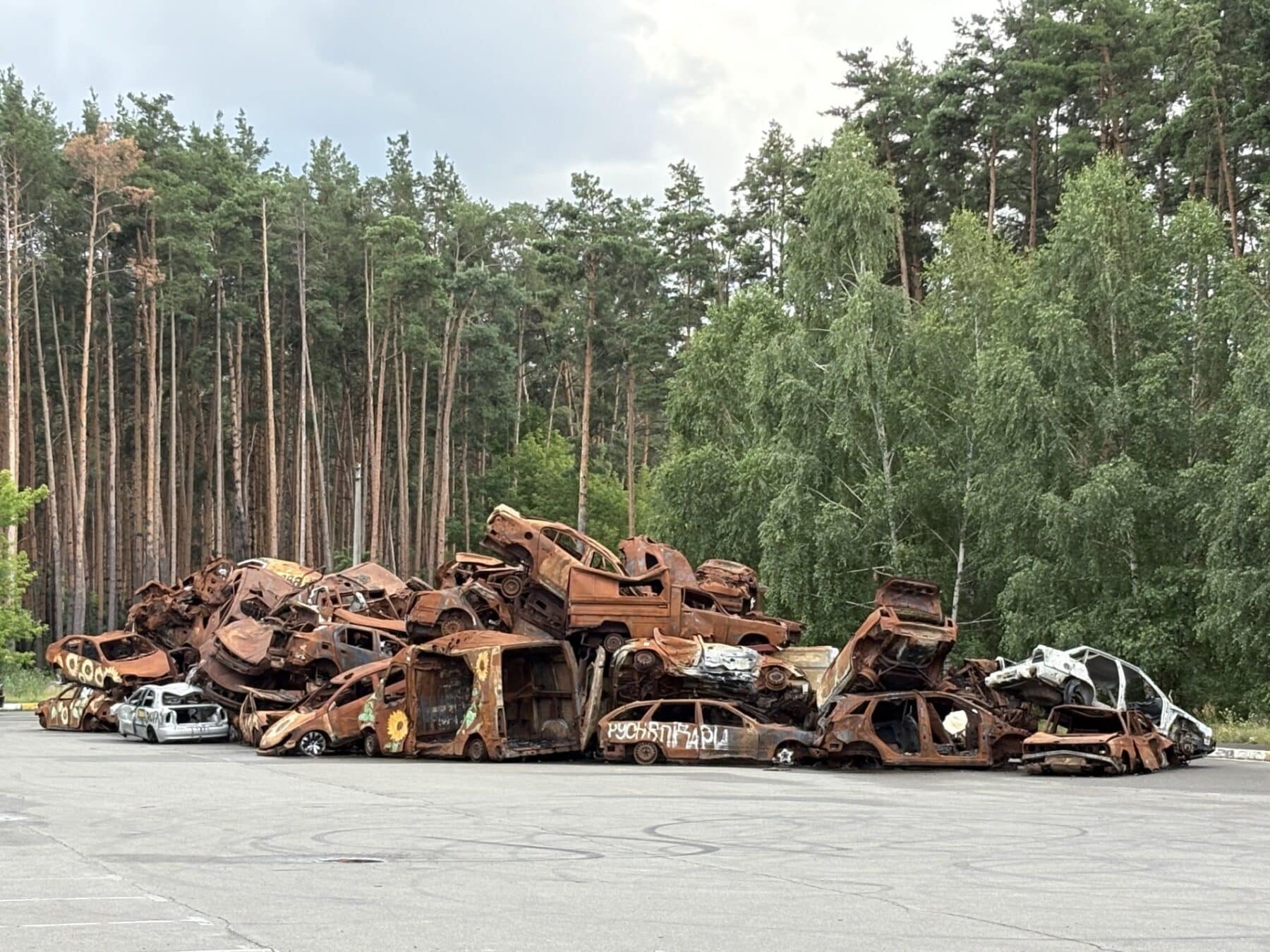
Black snow was falling when Serhii had to evacuate from Hostomel. Throughout the night, the shelling never stopped, and there were fires and smoke everywhere. They blackened the snow. Serhii had thought he could see such things only in films. He could not have imagined a full-scale war could take place in the twenty-first century. Since the full-scale invasion on February 24, 2022, he had sheltered with his grandmother in the basement of her house among boxes of potatoes and jars of last year’s berries. There was no water, heat, or electricity. It was dark and cold. They could not burn candles for long because, without good insulation, the air was too hard to breathe. Serhii brought a little shovel with him in case a missile hit the house and he had to dig them out of the ruins. In March, he managed to evacuate. Many others were not so lucky. The memorial of burnt cars on the outskirts of Irpin, near Kyiv, testify to how dangerous it was to leave the occupied territory.
Research on territories occupied or controlled by the USSR after WWII has usually been classified as part of the study of communism, Soviet socialism, totalitarianism, or authoritarianism. In the case of Eastern Europe, the Baltics, and Ukraine, “occupation” might productively be deployed as an analytical lens and an alternative to “post/socialist” or “post/Soviet studies.” While the terms “post/socialist” or “post/Soviet” inscribe countries within the Soviet sphere, “occupation” underscores pre- and post-WWII sovereignty of the states. It emphasizes continuity between the imperialist politics of the USSR and that of the Russian Federation. Since 1991, Russia has newly occupied parts of the territories of three sovereign states: Georgia, Moldova, and Ukraine. Terror, resistance, propaganda, passportization, filtration camps, fake elections, and referendums define occupations by the Russian Federation much like they did those of the USSR.
The post-2022 liberation of many occupied territories of Ukraine offers us an opportunity to collect testimonies of life under Russia’s occupation. After the Russian invasion on February 24, 2022, the Russian Army controlled about one-fourth of Ukraine’s territory. By late 2022, amidst counteroffensives in Kyiv, Kharkiv, and Kherson, the Ukrainian Army reclaimed 54 percent of the land Russia had captured since the beginning of the full scale invasion. Currently, Russia occupies about 115,900 sq km, or 19.2%, of Ukraine’s territory. However, as of February 20, 2026, it has been reported that 300 sq kilometers have been liberated in southern Ukraine.
In the context of current geopolitics, learning more about everyday life under occupation allows us to understand the intent of Russia’s war in Ukraine in more depth. While the Russian Federation veils its intent under euphemisms like “special military operation,” “liberation,” “denazification,” or “anti-nationalism,” people’s testimonies show that occupation is a destruction of life itself in order to establish the “Russian mir.” Occupying forces institute a totalitarian regime where people have no human rights or civil liberties. In over a hundred interviews with people primarily from various de-occupied areas, I have heard repeating stories of violation of human rights, and terror and violence inflicted upon them. These stories document experiences of occupation that Russia aims to eradicate in its billion-dollar propaganda directed at domestic and international audiences. Ukrainian testimonies, thus, are a form of historical truth and justice.
The people I interviewed compared their life under occupation to a life in prison. They spoke of constant animalistic fear, the inability to breathe, helplessness, feeling trapped, degradation, becoming bomzhi (homeless and poor), life like in a concentration camp. The youth drew parallels with dystopian computer games like Half Life 2, about a planet overrun by aliens and a police state. Under occupation, each day was similar to the next, like in the 1993 American fantasy film by Harold Ramis and Danny Rubin, “Groundhog Day.” Daily activities became focused on survival. Many lived without electricity, gas, and water for weeks, and getting food in some areas became a dangerous ordeal. Internet was available only in some places and often required a fee paid to middlemen. Some people climbed into the highest buildings with their cellphones and waved their hands to use the internet or drove to highest hills in the area to get a signal.
People’s testimonies show that occupation is a destruction of life itself.
Olena, a teacher from Kharkiv Oblast, thought that “only death is worse than occupation.” Under occupation, she confined herself to home and hardly spoke to her neighbors out of fear of being denounced. She lost twenty pounds in just a few weeks because she could not eat. While the occupational authorities brought humanitarian help and started supplying food, many people reported not being able to eat this food because it did not taste good. Some paid significantly more money for Ukrainian products. Ukrainian medicine soon became unavailable, while Russian medicine had little or no effect. Olena stopped dreaming about her future because nothing was certain. She felt humiliated by being treated as nobody, an enemy, forced to become Russian and live in deprivation. She taught schoolchildren in a basement hiding from the authorities. Living in constant fear, she tried to preserve the identity of her people. Russian authorities say Ukrainians do not exist: Olena and her schoolchildren knew that they do exist. After six months, her city was liberated. Although she suffers shelling almost every day, she says it is better because she is free.
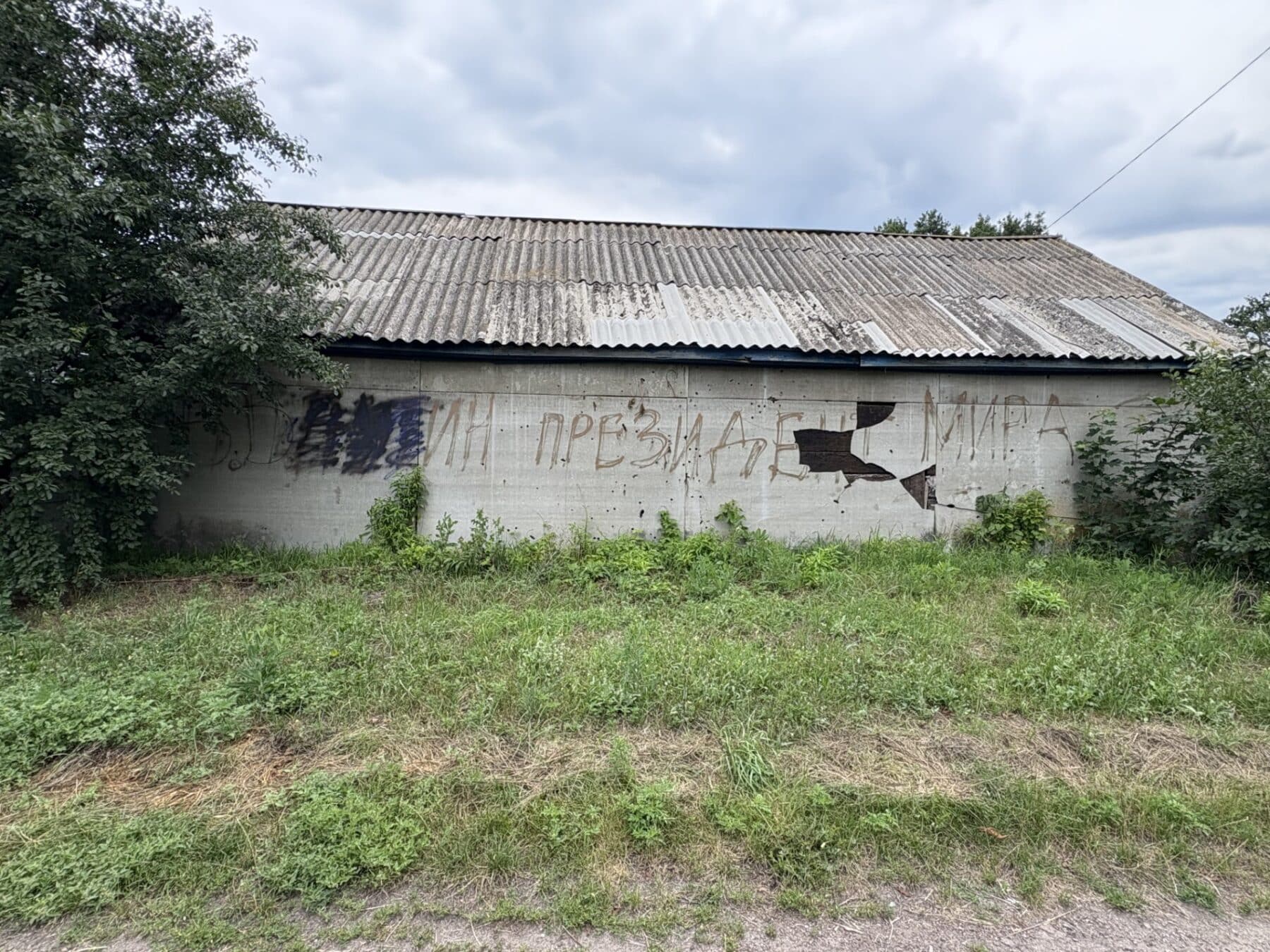
Dmytro lived in an occupied rural settlement in Kherson Oblast in southern Ukraine for three and a half years. His parents only let him or his siblings venture out into their yard. When he turned 18, he left his village to “visit” his brother in Poland. There was no brother in Poland – Dmytro did not know anybody outside his home village. By staying home, however, he risked being mobilized to the Russian Army and sent to the front. Like Olena, he was nobody. He was beaten at the Russian checkpoint, but they let him go. “What would have been your life like,” I asked Dmytro, “if your village was not occupied?” He mused, “I would have spent a lot of time with friends, we would go to the park for walks, go to a city, eat pizza.” He is now by himself in Kyiv without his parents, money, or a high school diploma, with nothing except freedom. “I want to study,” says Dmytro, “and, later, to enroll at a university. I want to learn English.” Unlike Dmytro, others cannot leave. They have sick parents, have no money for paying bribes to get through the checkpoints, are afraid to become homeless or live in poverty. They are afraid to find themselves without the small measure of security that their home in occupation still provides. Some write “God bless my home” on the outside walls of their house, so that God can see through the flying drones and smoke of fires. These are the reasons some return to the occupied territories as well. All of them juggle multiple insecurities as they try to survive and care for themselves and others. Moreover, some are afraid to be looked down on as collaborators with the occupying forces since the Russian propaganda advances discourse that they are now enemies of Ukraine.
“Occupation is like a trap,” explained Dariia from Donetsk, which was occupied in 2014. She left Donetsk when she turned 19, having spent 9 years there. “Occupation entangles you like a spider web. It’s easy to get in and hard to get out.” She recounted how students were made to draw Peter the Great and “Z” signs at the art school. What if you never truly escape occupation, I wonder, even when you are liberated? Like Marichka, who endured only a month in occupation in Kharkiv Oblast right after the full-scale invasion. She remembered how Russians lined people up by the fence and told them that they were part of a “Russian narod [nation].” “Those who refused to accept it were shot on the spot. Thirty people were killed. They also came to people’s homes to take the girls away.” Marichka was just fourteen and, thanks to her mother, who shouted and swore, they did not take her. “Others were not so lucky.” To survive and feed her young siblings, she crawled through the field to the store to steal food, entering through a broken window and collecting everything she could stuff quickly into her backpack. They ate dry macaroni and canned meat. Marichka’s memories mix truth and reality: some memories are false, but the horror is true. There were no mass executions in her village, but there were killings and rape, like in many other places of occupation. She remembers a collective story: she is Ukraine. Marichka has not left the occupation even when her village was liberated. Will she ever? She is only 18.
What does it mean to lose your home?
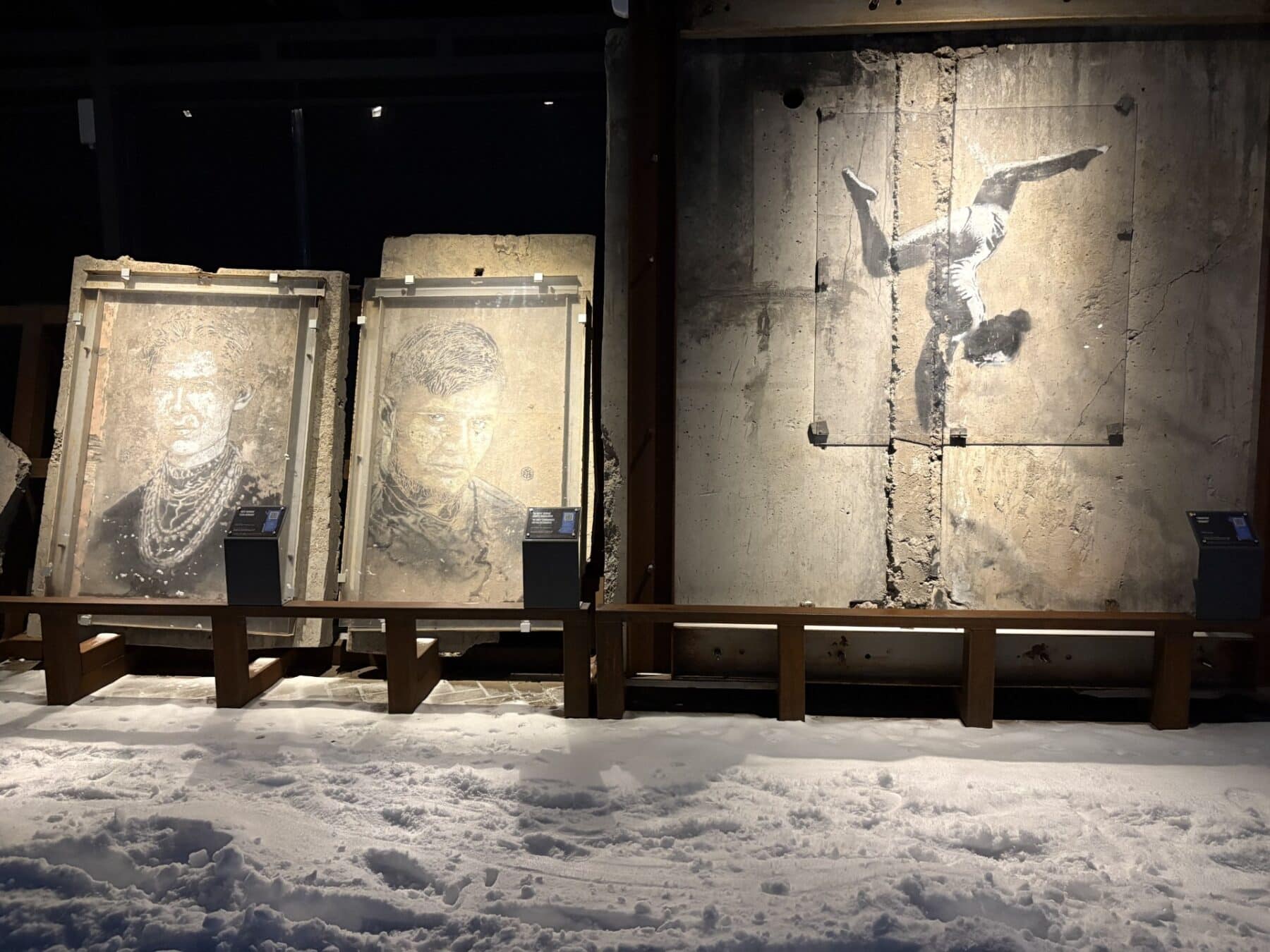
Liberation has been very uneven. In Borodianka, the Russian planes dropped multiple aerial bombs on apartment buildings. After the bombing, locals could hear screams from below the ruins for several days. The soldiers of the Russian Army did not allow them to help those who were still alive. Last winter, the last house that remained standing, a monument to those terrifying days of the beginning of occupation, was removed. Some cities, like Kupiansk, were not destroyed because the Russian Army occupied it without much resistance. However, it is now a frontline and no longer livable—reduced to a ghost city with dark empty windows in the high-rises that are still standing. Some people are still here, hidden in basements, gambling with a brutal imposed destiny and hoping to stay alive. As I walk through Kupiansk in my imagination, I see its blooming apricot trees, the quiet Oskil River winding around the city, storks clattering on the nests of electric poles, and dogs barking in every yard. The metallic sound of trains surrounds every home. Against the hush of the trains, people wake up, have breakfast, and rush to work in the train depot. What does it mean to lose your home, I wonder. The home that you built your entire life, the garden you planted with your hands, everything filled with dreams and memories. The elderly would say: “I planned to retire and live peacefully there, then leave it to my children.” Some stayed in their homes during occupation, protecting them with their bodies. They knew that if they left, the Russian soldiers would loot and destroy everything. In the Kyiv oblast, people saw them take washing machines, TVs, computers, they even took used underwear; everything they could carry when they had to retreat. In Velyka Dymerka, when a tank crew ran out of space, they hung a bucket loaded with things from Ukrainian homes on a tank barrel.
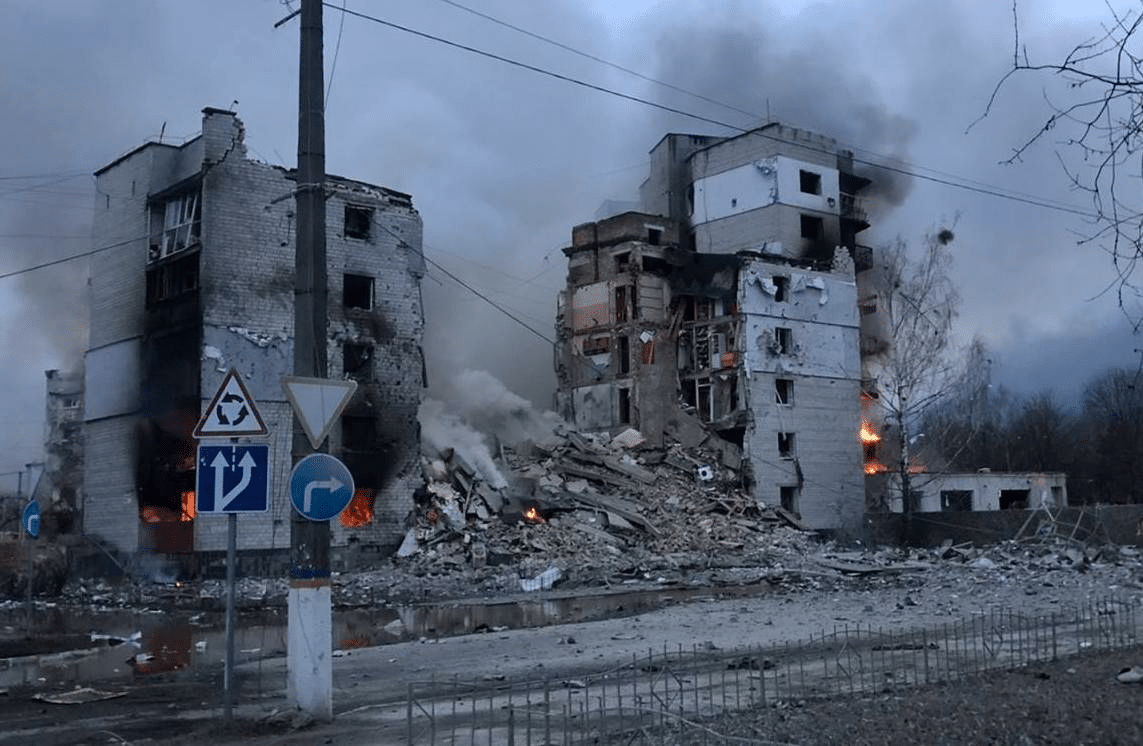
Destroyed cities are standing memorials to urban life. “We will rebuild our cities,” says a soldier in a film about liberating Andriivka. It is his land which embraced the bodies of his friends, for him it is sacred. Nobody wanted this war or this sacredness. Many cannot bear the pain flooding their homes and lives. Others wish nothing more than just to survive. Just to go to the park with friends, like Dmytro. To live without being afraid to be seen, like Olena. To not feel trapped, like Dariia. The war terror subjugates the population. This winter, with attacks on the energy sector and the bombings of the infrastructure in many Ukrainian cities and regions, which left thousands of people without heat and electricity in subzero temperatures, is just another example of violence against life itself. Some may put their heads down and agree to live in prison. This is a choiceless choice. The occupation does not mean peace. It means terror, death, and deportations, and prison-like life for many others. Those who lived under it in Crimea, Donbas, and the territories occupied in 2022 know it so well. “When I was evacuated to the territory controlled by Ukraine, I could finally breathe,” remembered Tania from Kherson. “I cried and hugged our soldiers, after I passed the last Russian checkpoint,” recalled Dmytro. “It was the happiest day of my life, when I saw the Ukrainian Army in the city,” says Oleksandra, tearing up. “An old lady brought me a jar of tomato juice,” recalled Valentyn, a Ukrainian Army soldier who liberated Mykhailivka-Rubezhivka, near Kyiv. “She apologized since it was all she had left after a month of occupation.”
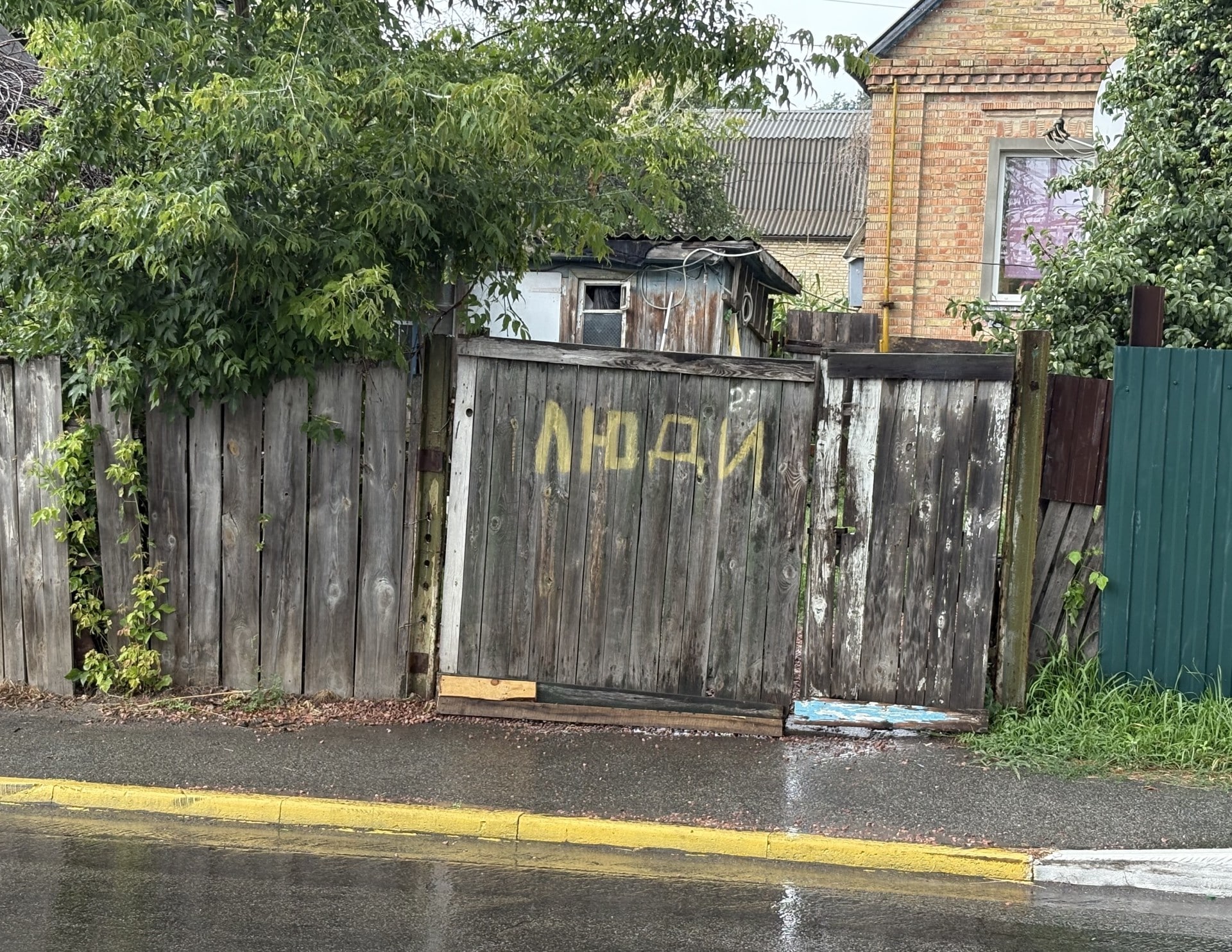
Total occupation is never possible. Resistance takes many forms. In the beginning of the occupation, people went to protests and took up arms. Later, they hid at home, counting Russian military equipment and sending messages to the Ukrainian Army. Some refused humanitarian aid, did not accept Russian passports, did not watch Russian TV, did not vote in referendums. A few children in Kherson would secretly draw Ukrainian flags on light poles with chalk. Speaking Ukrainian, teaching Ukrainian underground, wearing vyshyvanka (the embroidered Ukrainian dress or shirt), not attending reorganized schools, burying institutional archives, volunteering to help others, even taking care of homeless animals all constituted forms of resistance to subjugation and dehumanization during occupation. Oleh from Kherson did not leave home for eight months, afraid to be captured and interrogated. He created music, his favorite composition entitled “A Beautiful Piece.” Being a human is a form of resistance among “non-human” occupiers (ne liudy). His wife would mess up her hair and dress in old and indistinct clothing to go to the store. By the store, she would stop to have a smoke with a salesperson. They both would nod “f*ck them” to each other instead of saying “good morning.”
Former prisoner of war, journalist, and human rights activist Maksym Butkevych claims that “violence is the main opposite of freedom, its antithesis… Captivity is the occupation of the person in all the details of his or her daily life. Occupation is the captivity of many people who are denied the opportunity to influence their own destiny. By taking away freedom, the occupiers also take away a piece of humanity, that which makes us human, the ability to choose our own path. And that’s why the escape from captivity and departure from occupation, are often described as liberation, return to freedom.”
“What is most important for people in the Russian prison?” I ask Maksym Butkevych. The answer is written on his hoodie: “You are not forgotten.”
Neringa Klumbytė is Professor of Anthropology and East European Studies and Director of the Lithuania Program at the Havighurst Center for East European, Russian and Eurasian Studies, Miami University as well as Senior Research Scholar at the Lithuanian Institute of History.