At the end of January, both chambers in the U.S. Congress voted on a bipartisan basis to fund the U.S. Department of Education’s Title VI international education programs through the Consolidated Appropriations Act of 2026 (H.R. 7148). Such bipartisan support used to be the norm for one of the most formative partnerships between the federal government and U.S. higher education. Since Title VI’s creation through the National Defense Education Act in 1958 (Sec. 401-405 and Sec. 601-611) and its revision under the Higher Education Act of 1965 (Parts A-B), backing across political divides has seemed straightforward. How could it not be so?
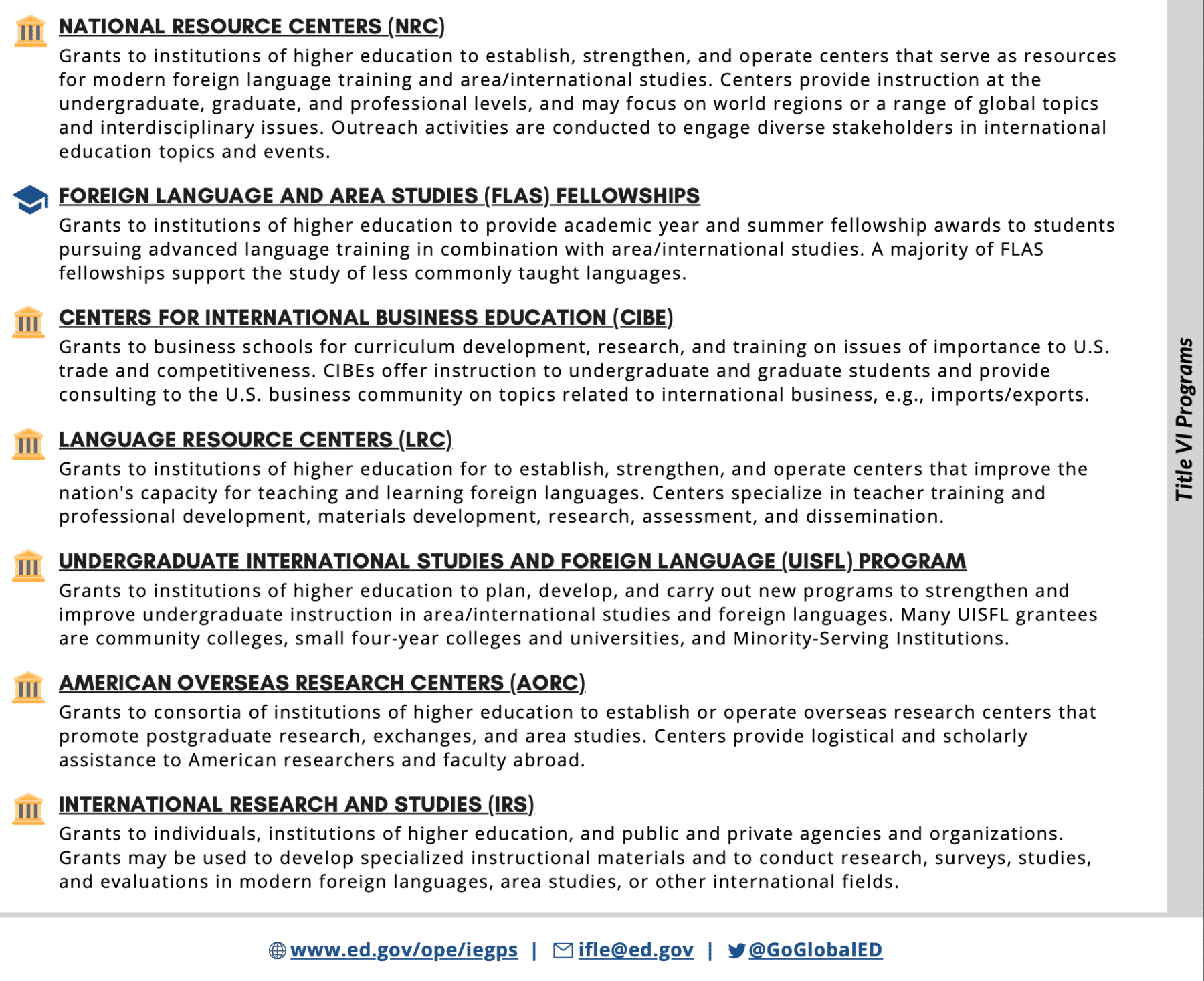
Born of the Cold War era, Title VI programs formed the backbone of U.S. capacity in international education. For a small fraction of taxpayer dollars, these programs built a critical and comprehensive infrastructure without which federal agencies could not implement complementary initiatives like the U.S. Department of Defense’s Language Flagship or the National Security Agency’s STARTALK programs. Title VI grants to institutions of higher education and fellowships to U.S. citizens, nationals, and permanent residents pursuing global and regional studies—especially education in less-commonly-taught languages—were cornerstones of a national strategy aimed at creating international expertise across employment sectors, a globally competitive workforce, and a citizenry knowledgeable about different world regions. As engines of innovation in research and teaching, higher education institutions were well-positioned to share new research and high-quality instructional resources with all levels of the education system. Universities were also the main conduits for training the experts central to this strategy—the scholars and language instructors, educators from pre-K to the post-secondary level, and the broad spectrum of education professionals core to the entire education system. In the irreversibly globalizing age that followed, bipartisan investment in such programs made more sense, not less.
The Funding Cliff
Project 2025 promised to reform area studies funding and significantly prefigured the cascade of developments last year. In spring 2025, as part of a broader reduction in its workforce, the Department of Education disbanded the entire International and Foreign Language Education (IFLE) office, including the seven staff members directly administering Title VI. The programs were then transferred to the Office of Postsecondary Education and assigned to four staff members already managing full portfolios. In March-April 2025, federal funding freezes directed at Ivy League institutions affected a handful of Title VI grantee centers, albeit unevenly: some had support entirely suspended, while others remained cut off from their grants despite the resolution of federal investigations and the overall restoration of funds to their universities. In fall 2025, the other shoe dropped. The Department of Education sent all 228 Title VI grantees the same non-continuation notification, cancelling current grants across all seven programs in September. The notification provided no evidence that individual grantees failed to meet eligibility, performance, and compliance standards, as required in the Code of Federal Regulations. Instead, Title VI programs and their grantees’ activities were declared to be “inconsistent with the Administration’s priorities” and not advancing “American interests or values.” The announcement of Education’s interagency agreement (IAA) with the State Department only amplified questions about the future of these programs. By this time, the President’s and the House budgets proposed defunding Title VI again in FY2026. And while bipartisan endorsement in the Senate Appropriations Committee offered the first glimmer of hope for preventing a repeat of FY2025, there were serious concerns that defunding Title VI for three consecutive years (FY2025-2027) was part of a long-term plan to sunset these programs indefinitely.
For FY2025, Congress ostensibly provided level funding for Title VI via a full-year continuing resolution (CR). This CR did not contain express language instructing the Department of Education as to how it should spend its funds. It was this congressionally-approved flexibility that smoothed the way for Education to defund Title VI in September 2025 through the non-continuation notifications sent to Title VI grantees. While the Department’s overall compliance with the Code of Federal Regulations remained unresolved, the notifications did provide higher education grantees the option to file reconsiderations requests. However, the Department also made it clear that all available funding was already repurposed to other programs, which raised the following question for grantees: was the option to file reconsideration requests entirely performative and any appeal therefore an exercise in futility?
To assess institutional responses across the higher education landscape, the Council of National Resource Centers in International and Area Studies surveyed 124 grantees in the two flagship Title VI programs (NRC and FLAS; ~$60 million in combined funding). With a 90% response rate, 80 centers and programs confirmed filing tailored reconsideration requests in fall 2025. These appeals routinely cited performance data from filed grant reports, in which grantees had already established meeting NRC and FLAS program goals and thus proved that their activities were consistent with the Higher Education Act and with “American interests and values.” As with the non-continuation notification, Education sent the same blanket denials by September 30 without any tailored response to grantees’ appeals. While no funding was reinstated, the filing of the reconsideration requests was hardly futile. Rather, the grantees engaged in a concerted effort to record, track, and document the strong legacy of these programs based on which restoration could once be achieved.
The Impact
The defunding of Title VI in 2025 had devastating effects. Most immediately, the Department’s cancellation of grants wiped out over $30 million in FLAS Fellowships to around 1,900 meritorious undergraduate and graduate students planning to pursue over 100 less-commonly-taught languages in order to complete degree requirements. In SEEES, the 14 FLAS centers would have awarded around $4 million annually through approximately 220 fellowships, in addition to awards typical made by other FLAS-funded centers in Asian, European, Global, and Middle Eastern studies. Among the students, the hardest hit were academic year fellows, especially PhD students for whom acquiring advanced language proficiency is critical to the completion of research and dissertations. Despite the uncertainty around Title VI, grantee centers ran academic year competitions for 2025-2026, selecting based on merit and with preference given to financial need; however, students received only tentative award letters. Once the defunding of Title VI became reality, many grantee centers combined FLAS funding from previous years with stop-gap support from their home institutions to cover academic year fellows. However, due to divergent institutional capacities, universities could not offset a funding disruption of this size and students already in need faced heightened financial precarity. As Inside Higher Ed reported, some graduate students needed to enroll at different universities while others “were forced to make the decision about whether to come to campus without knowing if they would receive the scholarships they’d been promised.” Simultaneously, degree completion rates in languages and international and area studies came under risk for multiple cohorts over the next several years.
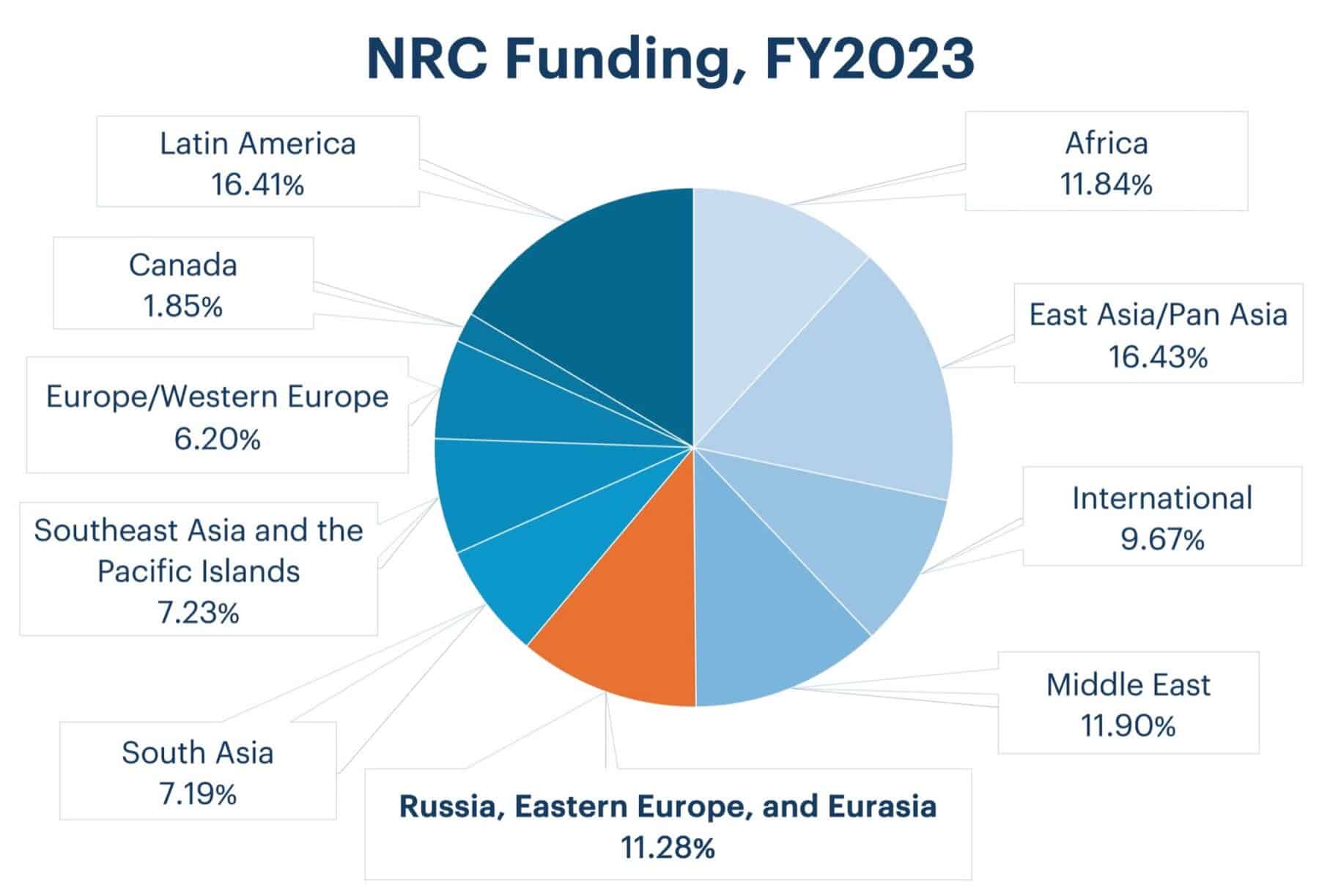
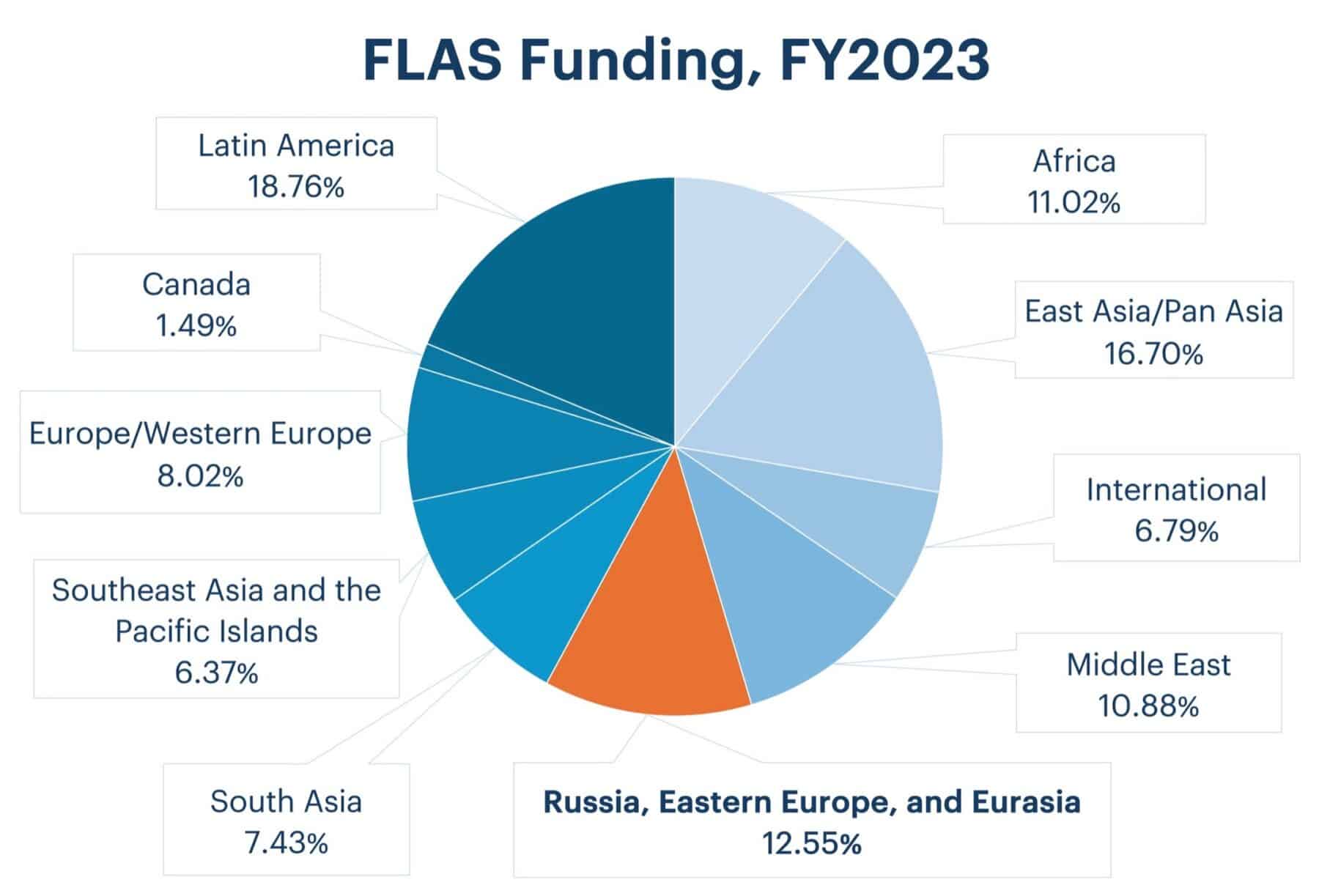
To maintain eligibility and competitiveness for NRC and FLAS grants, universities make a significant commitment to invest in the depth and breadth of less-commonly-taught languages as well as global and area studies at their home institutions. Such investments maintain a large pool of tenure and non-tenure stream faculty in multiple disciplines; fund faculty research, mobility, and new course development; support students’ advanced language immersion, area studies learning, and their training for diverse careers; create student programs and teacher training workshops at all educational stages; and retain highly-trained administrative staff with the institutional knowledge and area expertise to ensure operational capacity.
The cancellation of Title VI grants removed these investment incentives overnight. As Inside Higher Ed and institutions such as UCLA and UW Madison reported, some non-tenure stream faculty positions in less-commonly-taught language programs promptly became subject to a hiring freeze or were terminated, their faculty departing or placed in a hiring limbo. At UT Austin, language departments including Slavic and Eurasian Studies were consolidated, which may depress the quality of higher-ranking PhD and other degree programs. Universities like IU Bloomington, which cover the vast linguistic diversity of our world region, are confronting difficult choices about which languages to keep or eliminate. In heightened jeopardy are federally-designated critical languages (Azeri and Russian) and the less-commonly taught languages of the Baltics, the Caucasus, Central Asia, and, crucially, Ukraine.
The termination of over $3.3 million in National Resource Center grants to 13 centers in Russian, East European, and Eurasian Studies further disrupted operational capacity and resources available in our field in dramatic ways. Two categories of positions, typically grant-funded, became immediately precarious. In the first category are Outreach Coordinators who create educational programs for the public, including students and educators from the pre-K to the post-secondary levels, policymakers, as well as business and media professionals. Outreach Coordinators are key to bridging university expertise and public need by developing programs in partnership with school districts, minority-serving institutions, international partners or diaspora communities. In the second jeopardized category are FLAS Coordinators, responsible for managing all stages of the fellowship from applications to awards and grant reporting. In certain cases, professionals in both types of positions received layoff notices effective Spring 2026; others moved to new positions on their own or are planning to do so with leadership support. Some centers received no operating budget for 2025-2026 and, although a few positions were guaranteed, faculty directors faced uncertainty about their course releases while Associate Directors confronted questions about the future of their positions. Then, in a shocking piece of news, UNC-Chapel Hill formally announced plans in January 2026 to shutter its six area studies centers.
A Future for International Education Programs?
The passage of H.R. 7148 in January 2026 was momentous for restoring funding to Title VI in 2026-2027. This Act included a new provision that the Department of Education must maintain adequate staffing levels. Due to concern over the interagency agreement (IAA) between Education and State, Congress additionally required all parties to prepare biweekly performance reports showing effective grant administration based on metrics comparable to previous years (e.g. adequate staffing, implementation costs, and the integrity of independent peer review during the award process). Although this added congressional oversight is encouraging, the appetite for enforcement at the Department of Education remains unpredictable.
Meanwhile, these international education programs continue to be mired in uncertainty around a set of three complex questions and challenges. First, will there be a Title VI competition this year, and if so, for which Title VI programs? The Department of Education has the authority to determine which programs to fund but it is required by law to obligate funds by September 30. This year was initially slated to be a major competition year because Education is due to run competitions for five out of its seven Title VI programs, including NRC and FLAS. Yet the Department is more than seven months behind schedule on a complex process. Second, will there be sufficient institutional expertise and operational capacity to run multiple competitions? The four designated staff members in the Office of Postsecondary Education started handling Title VI programs in September 2025; this change meant adding 124 NRC & FLAS grantees to the portfolios of two staff members who already had full assignments. Third, how will competitions and grant administration evolve? If early reports on the Education-Labor interagency agreements are any indication, stakeholders would be hard-pressed to expect more efficiency and cost-effectiveness in the management of Title VI. How Education and State respond to these three challenges will deeply shape these international education programs in the next couple of years.
Area Studies Beyond Title VI? Key Lessons, New Models, and Core Questions
Despite the unprecedented crisis that emerged in 2025, there is plenty of positive news. In addition to Congress supporting Title VI on a bipartisan basis, the next most encouraging update was UNC-Chapel Hill announcing that it was revising its decision on center closures. When the news broke in December 2025 that UNC was closing its centers for African, Asian, European, Middle Eastern, Latin American, and Slavic, Eurasian & East European Studies, the response was immediate and overwhelming. “Current and former students, community partners, K-12 systems, prisons, and international partners rapidly mobilized,” said Graeme Robertson, Director of the Center for Slavic, Eurasian & East European Studies. “The Chancellor and the Provost received over 400 pages of ‘love letters’ from U.S. and international institutions, prison directors, and students, including an undergraduate student who studied Russian while in a homestay in Kyrgyzstan—her first trip out of the U.S.” Now archived, these letters made clear the enormous reputational cost of closures. “Area studies centers may look small,” Graeme reminds us, but “what our home institutions often don’t realize is that we all have an extraordinarily outsized impact because of the excellent programs we create on shoestring budgets and with minimal staff.”
At other institutions, pioneering collaborative approaches are leading the way. At a January 2026 meeting of the Council of National Resource Centers, discussions revealed multiple strategies whereby centers and institutions are meeting the current moment. Several universities have shown a commitment to keeping centers intact, despite the precarity of funding. The Big Ten Academic Alliance is now pioneering a consortium model for Central Asian Studies and related humanities fields to strengthen doctoral education, building on language education that is already coordinated across several consortium institutions. Other centers are working to establish language-sharing initiatives through technology, launching mentorship programs across institutions, and actively pursuing foundation and donor support to bridge funding gaps.
In 2025, universities with decades-long investment in international and area studies learned that Title VI funding and the nearly 70-year-old partnership with the federal government were unreliable. In addition to triggering wide-scale disruption and innovative responses at many institutions, this development also raised critical questions about the mission, infrastructure, and future sustainability of area studies.
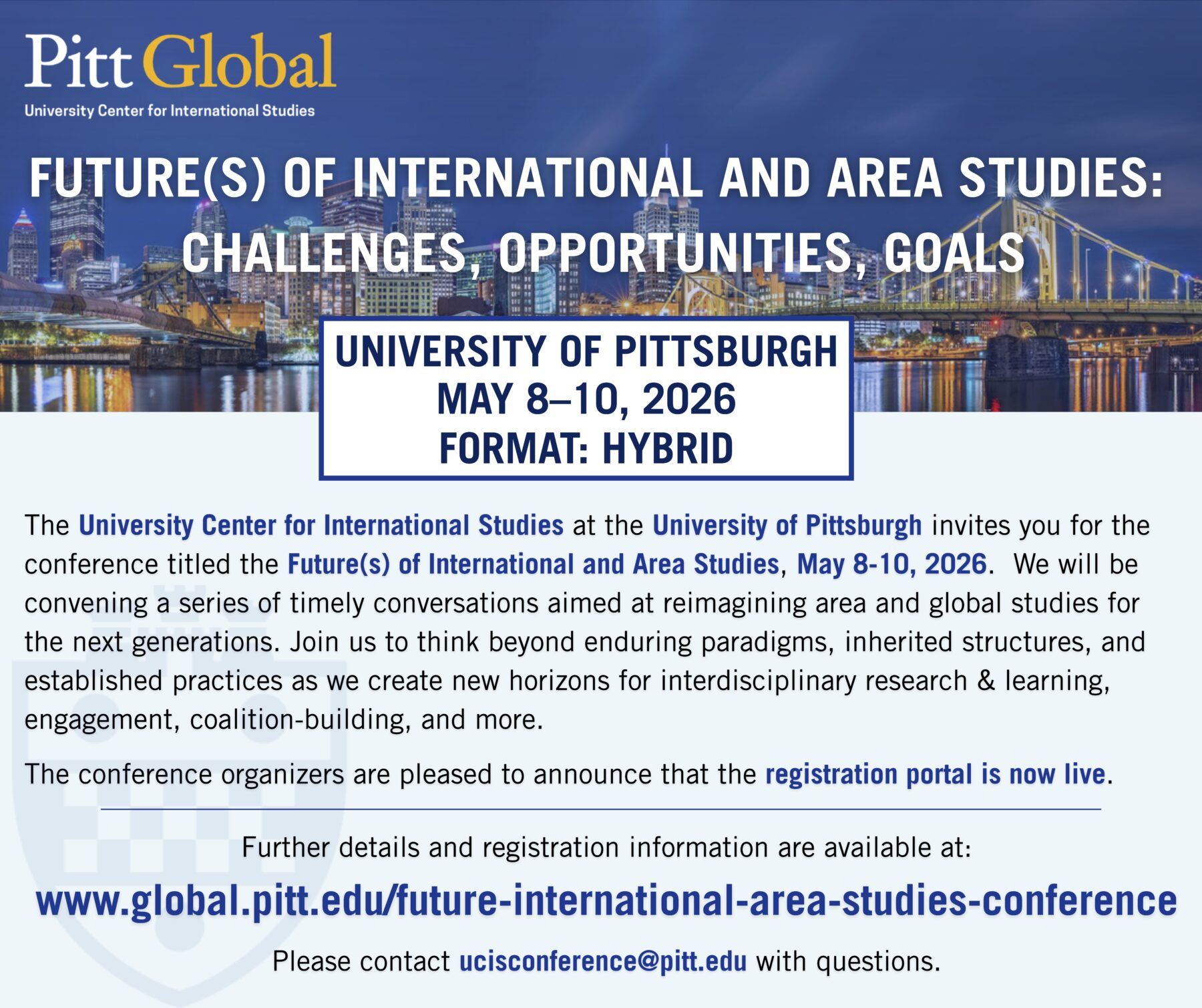
These questions are the rationale for the conference Future(s) of International and Area Studies, to be hosted at the University of Pittsburgh on May 8-10, 2026. “Political headwinds are structural, not temporary,” said Allyson Delnore, Interim Executive Director of Pitt’s University Center for International Studies. “We are in a different world than the one in which area and global studies centers were first created. But we are also uniquely positioned to understand that world. We think of this conference as one moment in a longer conversation about priority topics and issues that other centers and universities will want to pursue in a collaborative spirit.”

Zsuzsánna Magdó serves on the Executive Board of the Council of National Resource Centers in International and Area Studies and is a Member of the Board of Trustees at the American Institute for Southeast European Studies. In her main capacity, she works as the Associate Director at the University of Pittsburgh’s Center for Russian, East European, and Eurasian Studies where she manages regional studies programs to support interdisciplinary scholarship and public education on the world regions of Central and Eastern Europe and Eurasia. A native of Transylvania, Dr. Magdó received her Ph.D. in History from the University of Illinois in Urbana-Champaign.