ASEEES thanks Douglas Rogers (Yale University) for chairing the prize committee and formulating the interview questions.
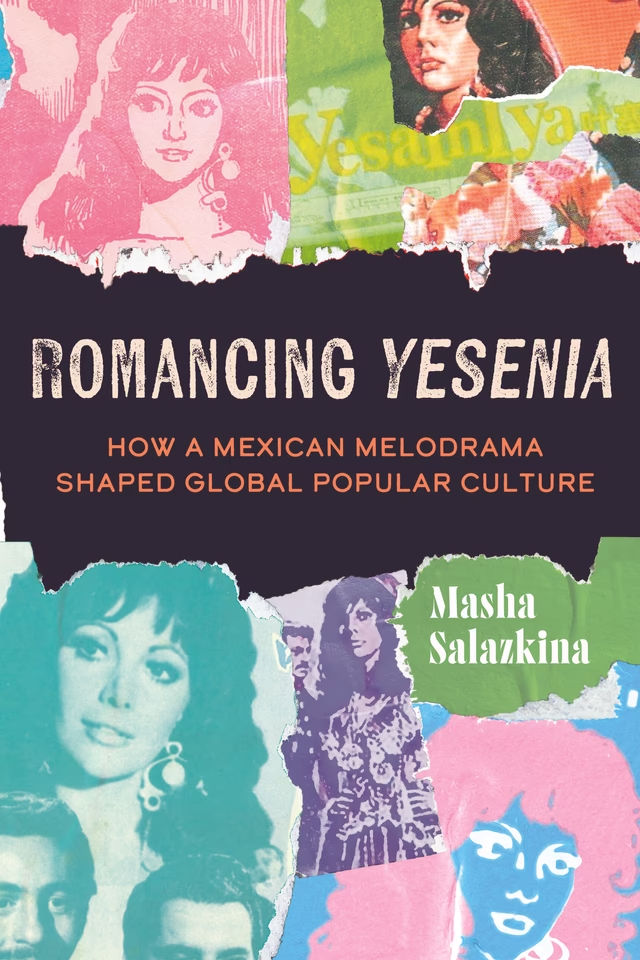
of California Press, 2024)
What drew you to this topic?
Over the years, I came across many books on the history of Soviet cinema that mentioned a curious fact—that the highest grossing movie in the history of Soviet film exhibition was a 1970s Mexican melodrama. I had never seen the movie myself—either as a child growing up in the Soviet Union, or later, as a student of cinema in Mexico. But because my first book was on Eisenstein in Mexico, I have been asked about it over the years. But, of course, my prior work on Mexico—which was, after all, on the postrevolutionary avant-garde cultures of the 1920s and 1930s—had not in any way prepared me to answer that question. To most people it just seemed a strange thing that a socialist country—one that produced so many important films—would be crazy about a Mexican melodrama that most people had never heard of.
Then a few years ago, the film website MUBI contacted me about a podcast on movies with weird international exhibition histories, including ones that were inexplicably more popular abroad than in their home countries, and they wanted to talk to me about Yesenia. I decided that this was my chance to get to the bottom of the story.
Why do you think that scholars overlooked the popularity of Yesenia for so long?
There is of course the pragmatic reason—which is that because it is a topic that involves popular culture of the Soviet Union and Mexico, to engage with the question of this film’s popularity, you would need to know a lot about both. Even if one were to take just the reception (i.e. Soviet) side of this story, because Yesenia is a minor movie (and a remake of a soap opera that was itself a version of a comic book series), not part of the world cultural heritage, so to speak—it’s not Frida Kahlo or One Hundred Years of Solitude—it’s not easy to know what to make of it unless you know the Mexican context and have access to those materials, which are not that easily available.
But, of course, there is also the issue of the cultural and academic value of doing work on something that the majority of academics consider to be, simply, trash. In fact, as so much of the book ended up being about the formation of taste culture and the Soviet intelligentsia’s disdain toward popular culture, and especially popular culture from what we now call the Global South, it was fairly obvious to me that this attitude is not all that different from that of most of our contemporary academics.
Why is melodrama an important topic for you? What kinds of insights does attention to it enable?
I was not initially interested in melodrama per se—this focus emerged only as I looked into the reception of the film in the Soviet press in the 1970s. I was genuinely amazed by what a moral panic its success triggered—and, at the same time, how ardently audiences defended it against the critics’ attacks. “Melodrama” was the term that seemed to crystalize this opposition at that moment—as a genre or mode that was simultaneously not supposed to be part of the socialist aesthetic repertoire, but was, in fact, extremely prevalent and powerful. And, as everywhere in the world, it was also a term that was very gendered, associated with femininity, thus foregrounding many of the dynamics within Soviet sexual politics, which is a topic that has always interested me.
How have concepts such as “popular” or “melodrama” themselves have been understood and explored differently in these different contexts?
And as much as my book is really a history of the global 1970s, there are so many issues in this story that still resonate today: our false assumptions about what could and could not be popular in any given place; the rift between the scholars of cinema and the regular viewers over what touches them; or what is considered “progressive” or “backwards” politically at any given moment.
How do you see this book making contributions beyond the ASEEES region, for instance to the study of “global popular culture”?
One of the objectives in writing this book for me was to show that the media world was much more interconnected before globalization than we tend to assume. Even more importantly, I wanted to challenge many assumptions that are still held within the Anglophone scholarship: whether it’s about the primacy of American or “Western” media within popular culture around the world, or about the dominance of auteur or art films as the main form of transnational or “world cinema.”
But also, to make the point that in order to study global popular culture, it is crucial to engage not only with its regional and local manifestations, but also with the way that the concepts such as “popular” or “melodrama” themselves have been understood and explored differently in these different contexts. In moments of transnational exchange, these different notions also come into interaction, challenging us to theorize their relationship rather than just apply the familiar, dominant conceptual apparatus we’ve all learned. This for me is the methodological intervention of this book, to continue expanding our theoretical references and citational politics.
What are you working on now?
I continue working in two directions at the same time: one, continuing the strand which is very visible in my previous book, World Socialist Cinema (which won the ASEEES USC Book Prize in 2024), has to do with leftist political cinema around the world and its contemporary legacies. I have two co-edited volumes on cinemas of global solidarity coming out later this year (one with OUP, the other with meson press), as well as a guest-edited issue of Feminist Media Histories on developmentalism, gender, and media; and I am currently working as part of a collaborative project restoring the legacy of the Spanish-born, Soviet-educated Cuban filmmaker Rosina Prado.
And the other strand continues my engagement with popular culture: I am finishing a co-authored book on the global circulation of the German-Caribbean disco group Boney M (which, as most ASEEES members probably remember, was enormously popular all over the socialist bloc in the 1970s-1980s—but also beyond), and starting to work on a new book which picks up exactly where Yesenia leaves off, with the arrival of Latin American soap operas on (post)socialist screens in the 1980s and 1990s.

Masha Salazkina is Professor of Film and Moving Image Studies at Concordia University, Montreal. She is the author of In Excess: Sergei Eisenstein’s Mexico (University of Chicago Press, 2009), World Socialist Cinema: Alliances, Affinities and Solidarities in the Global Cold War (University of California Press, 2023) and Romancing Yesenia: How a Mexican Melodrama Shaped Global Popular Culture (University of California Press, 2024), and co-editor of Sound Speech Music in Russian and Soviet Cinema (Indiana University Press, 2015), Global Approaches to Amateur Film Histories and Cultures (Indiana University Press, 2021), and Teaching Migration in Literature, Film, and Media (2025). Her two new edited volumes, Cinemas of Global Solidarity (Oxford University Press) and Global Solidarity and/in Cinematic Practices. Conversations (meson press) are forthcoming in 2026.