Not the biggest filmgoer, but always game for a Pretty Woman type, I went to the movies last fall to see Anora, a new film by Sean Baker. I was utterly entertained by the escapades of this Brighton Beach sex worker and her carousel of antagonists, all associated, in some way, with the former Soviet Union. Now an Oscar winner, Anora is a new classic in that old canon: American movies about “Russia.” Accordingly, the film is preoccupied with figuring out what “Russia” means in the first place.
What does the immense popularity of this film mean for our work as scholars, teachers, and occasional public representatives of the regions indexed within it? I invited specialists in Armenian studies, film, race and ethnicity, and popular culture to weigh in; comparatists who take this film in all its transnational proportions. And, like the film itself, they’ve got a sense of humor.
— Fiona Bell, Graduate Student Representative, Communications Advisory Committee

Anora and Our Ethnic Projections
by Ekaterina A. Olson Shipyatsky
In Anora, Sean Baker offers mainstream audiences a rare look into the post-Soviet diaspora in the United States. But for Slavicists, Anora also offers a provocation to think about Russianness, and post-Sovietness, in the American context.
Anora Mikheeva (Mikey Madison) – who prefers to be called Ani – is either first- or second-generation post-Soviet. To the people who work with her at the Brighton Beach strip club, “Headquarters,” this makes her “Russian Ani.” But the film complicates and plays with Ani’s Russian-ness, and with ideas of Russian-ness and American-ness. We find out early on in the film that Ani’s grandmother only spoke Russian, which is how she is able to understand Ivan (Vanya) Zakharov (Mark Eydel’shteyn) when he speaks to her. But she doesn’t want to speak Russian back to Vanya, and tells him that he can speak Russian to her and she will respond in English.

But is Ani even Russian? Since the release of the film, commentators online have speculated on her ethnicity. Sean Baker has publicly described Anora as both “Russian American” and more vaguely as “from a post-Soviet state.” But the name “Anora” is, as the Times of Central Asia reports, “rarely ever used in Russia, but is fairly common is Uzbekistan” – prompting concern from some that Anora would become the world’s “image of Uzbek girls.” Others have read Ani as Jewish. She comes from a heavily Jewish neighborhood: The Forward points out that around 39% of homes in the predominantly post-Soviet Brighton Beach and Sheepshead Bay include a Jewish person. And another commentator goes as far as to say that she knows “a New York Jew when [she] see[s] one.” Inexplicably, there is also a Menorah prominently displayed in the Zakharov family’s luxurious Brighton Beach mansion – which Ani launches at Toros (Karren Karagulian) during the film’s lengthy fight scene.
But, in the diaspora, does it even matter whether Ani is Russian, Uzbek, or Jewish? In her workplace, she is “Russian Ani” regardless of her family’s ethnic roots. But in relation to Vanya, she becomes “American Ani.” During a whirlwind vacation in Las Vegas, Vanya marries Ani in order to “become American” and avoid going back to Russia. After the two are married, Ani returns to Headquarters to triumphantly indulge in dreams of finally making the quintessentially American upper middle-class pilgrimage to Disney World. And finally, when Vanya’s mother, Galina Zakharova (Darya Eksamova), swoops in from Moscow to chastise her son, she tells Ani that her Russian “sucks” and speaks to her only in English.
Given these themes, Anora could have easily been a tired refrain rehashing the angst of being “too American” for people from the country of origin and “too country of origin” for the Americans. But the film avoids such cliched conclusions. Many critics have noted that Anora sheds relatively little light on the titular character’s inner life. Cynical readings have suggested that this makes her “secondary, dependent, [and] subservient.” But I see it differently. By refusing to linger on the level of the individual, Baker is able to shift his viewer’s gaze to the level of the structural. In this case, rather than telling a story of how Ani navigates life as a first/second generation post-Soviet immigrant, Baker instead tells a story about how Ani is differently interpolated in her different environments. That is, how she is made “Russian” or “American” – contextually ethnicized.
Ani is enigmatic both in character and ethnicity. And both, I think, are part of the film’s power and provocation.

What fools these Caucasians be?
by Arpi Movsesian
I pretty much exclaimed at the house arrest scene when the blood-orange scarf, which takes on a life of its own in the film, is waved by Toros (Karren Karagulian), the Armenian handler for the Zakharov family. I’d seen this before. The 1967 Soviet film, Prisoner of the Caucasus, or Shurik’s New Adventures, employs a chromatically similar (yellow) scarf for the same exact purpose – to silence the objectionable female object. Except in both cases, in a Bakhtinian carnivalesque, the heroine reverses her role, becoming a subject, outwitting the traditionally comical characters who abduct her. To be precise, in these two films, the fools are Caucasian: Toros and Garnik (Vache Tovmasyan) in Anora are Armenian, and the three stooges, Tрус/trus/Coward (Georgii Vitsin), Балбес/balbes/Fool (Iurii Nikulin), and Бывалый/byvalyi/Pro (Evgenii Morgunov) in the Prisoner of the Caucasus are the recurring goons in Soviet cinema, who usually adopt whatever personae are necessary to enact their goonship, in this case, to kidnap a bride, you know, Caucasian style.
In our field, we are certainly not unfamiliar with exoticized representations of the unfamiliar as mysterious, backward, or straight-up dangerous.
In our field, we are certainly not unfamiliar with exoticized representations of the unfamiliar as mysterious, backward, or straight-up dangerous, whether in Pushkin’s portrayal of the empire’s “south” in A Journey to Arzrum, ranging from Kalmyk Circes to unintelligible fool-like dervishes, or the array of Georgian traditional clothing (chokha, papakha, etc.) the three Russian stooges wear as a disguise. They are all perceived as eccentrics, a prerequisite for the category of fool (e.g. buffoon, country bumpkin, clown, or other). The unintelligibility of such characters (too loud, too foreign) is not necessarily an inherent attribute, but a phenomenological one. The cacophonous comedic relief that thrusts itself into Anora, especially after the starkly different register of its first part, is the carnival that I savored, while anticipating that the spoken Armenian (often not subtitled) between Toros and Garnik would remain inscrutable for the non-Armenian speaking audiences of the film. Karren Karagulian, in an interview with Dr. Shushan Karapetian, notes that most of the Armenian dialogue between his and Garnik’s character was about “90% improvised.” Phrases from the criminal post-Soviet underworld (that have now become part of colloquial speech) are profusely utilized in code-switching fashion, including, “հորս արև արա ё* твою мать/I swear on my father’s life [+expletive in Russian]”; “ապե/bro”; “обратно в Рашшу/straight back to Russia”; “լավ տղա էիր նատուռի/you were a cool dude, naturi [Armenianized version of natural’no]”; etc. But more poignantly, the center-periphery binary remains intact through the language of historical hierarchies. For instance, when Anora’s now-husband Vania Zakharov (Mark Eidel’shtein) tries to kick his father’s thugs from the house, he says, “твоя Армянская жопа е** с моего дома/get your Armenian ass the f out of my house”; a similar directive appears moments later, in the same context, but this time in English: “You Armenian piece of s.” Anora/Ani (Mikey Madison) herself adopts this language dynamic, saying to Toros: “Oh, you’re the Armenian f I was talking to?” The racist language, which here relies on the mention of ethnicity, culminates in Aleks (Vlad Mamai), a relatively minor character and one of Anora’s husband’s friends, in the kitchen scene, referring to one of the Armenian stooges with “This [n-word]’s f insane.” In this diasporic space, too, Caucasians are seen as chernozhopye (black asses), but now, with a pejorative from the context of American slavery.
When considered within the triple stooge formula, one of the stooges, Igor (played by Iurii Borisov), is unlike the others. Well, most importantly, he is not Armenian, and thus, not foolish in the sense of the comic. His Darcy-like seriousness and sporadic noble intentions are perhaps more in line with the Shakespearean wise fool especially in the tragedies, whose main attributes are awareness, common sense, and a tinge of gloom. Hell, he’s even maybe a Hamlet type, not about to cast “[his] nighted colour off.” Igor’s black clothes, including his ever-present black hoodie meant to conceal and separate his character, are in contrast with the other two fools’ green and tan attire. Enter: the Russian hero, maybe even the savior. At least the film gestures toward the former, and definitely rests on the latter. But my tale as old as time ends here. The periphery remains predictably in the margins.

Neorealism in Émigré Disneyland
by Daria Ezerova
In the summer of 2022, I was hired to translate a script with a rather enigmatic title: “Anora.” My job was to give a rough translation that would help the Russian cast understand their roles. I also answered a few questions about the dialect of the New York diaspora, thereby fulfilling my dream of being to Brighton Beach Russian as Christopher Moltisanti is to New Jersey Italian in the second season of The Sopranos.
Fast forward to 2025: the name “Anora” is etched in everyone’s brain in the film’s distinctive pink neon cursive. Yura Borisov and Mark Eydelshteyn still aren’t household names in the US, but they’ve become known to American cinephiles. The story of a stripper and occasional sex worker’s short-lived marriage to an oligarch’s son has swept the Oscars, and deservedly so as a real work of cinema in an age when one doesn’t need to be Martin Scorsese to regret the total domination of the industry by Marvel’s adolescent fantasies.
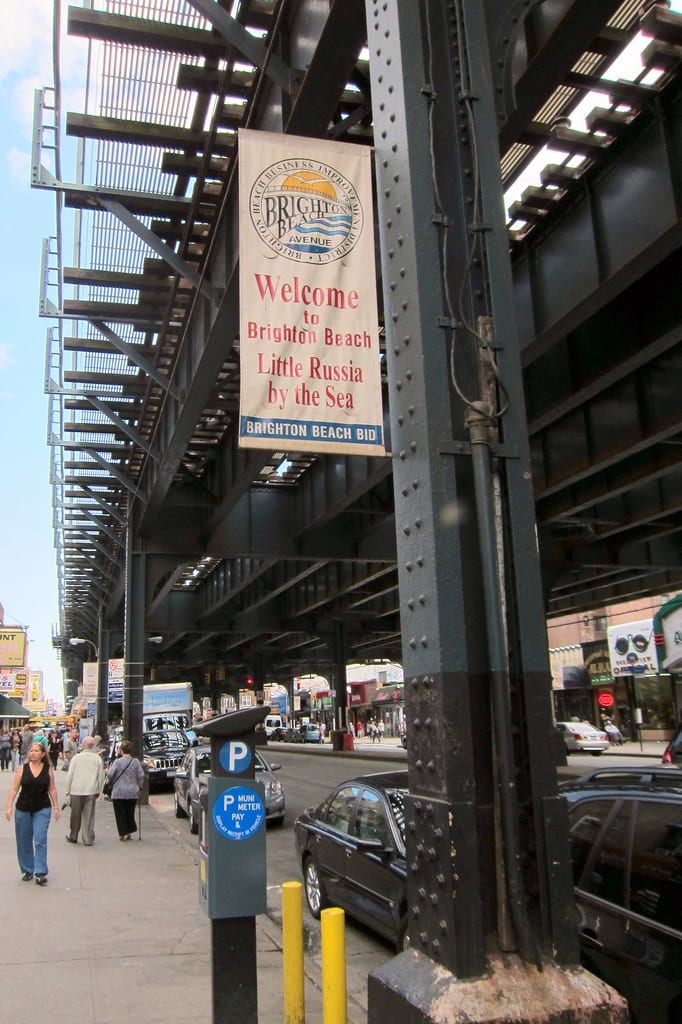
With Anora, Sean Baker continues to develop his distinctive style of twenty-first-century American neorealism. The topos of sex work as the epitome of the daily grind and a realist vision of urban and suburban dreamspaces are familiar from his previous films: Starlet, The Florida Project, Red Rocket, and the exquisite Tangerine. Anora’s Brighton Beach setting marks a new development in Baker’s oeuvre that gives it special relevance for Slavic Studies. If The Florida Project was a viscerally naturalistic work set in one of the fakest places on Earth, Brighton Beach provides a similarly striking cinematic space.
At the film’s London premiere, Baker said that he had wanted to make a drama set in the south Brooklyn enclave for years. Leonid Galdai’s Weather Is Good on Deribasovskaya (1992) and Balabanov’s Brother 2 (2000) frame the neighbourhood from the perspective of post-Soviet Russia, as a comical throwback to the 1970s Soviet Union, a historical theme park. But American filmmakers have shown its seamier side; in Darren Aronofsky’s Requiem for a Dream (2000) and James Gray’s Little Odessa (1994) and We Own the Night (2007), the neighbourhood becomes a backdrop for crime and urban anomie. Anora channels both of these visions — the comic and the tragic— as it roams the streets.
In the film’s longest sequence, a kind of odyssey across the neighbourhood, Brighton Beach becomes Bakhtin’s “chronotope,” or time-space. Time seems to stretch on forever for Anora alias “Ani” and the henchmen of the oligarch family whose teenage scion they chase from gaming arcade to nightclub, under orders to have his Vegas marriage to Ani annulled. It’s the neighbourhood as much as the wayward husband Ivan that seems to throw up obstacles for the unlikely fellowship of Ani and the goons, creating an odyssey-like structure of frustrated progress that has a distinctive texture and feel within the film.
Brighton Beach breaks the movie in two, a transitional space between the polar opposite spaces of the beginning and the end. The whirlwind romance of the first part of the movie, the Pretty Woman daydream, takes place in the fantasy spaces of the fuchsia-lit strip club and the luxury apartment that Ivan and Ani move through under the impulsion of sex, cocaine and ketamine (and love?). The closing sex scene, inside an old car, where the monotonous swish of the windscreen wipers against wet snow replaces the pounding beat of the strip club, couldn’t be more different. It’s in the movie’s middle segment, against the background of Brighton Beach, that fantasy and reality collide (often to comic effect). It’s here that Ani’s dream of a life of luxury proves as healthy and long-lasting as Coney Island cotton candy, but also perhaps that the viewer learns to look beyond the visual pleasures of pink neon and unimaginably expensive real estate.
The film has divided opinion among sex workers, to whom Sean Baker dedicated it in his Oscar acceptance speech. On the Party Girls podcast, Jamie Peck and Indica Dominant discuss failings of verisimilitude, as well as the pressure on any film representing sex workers given that there are almost no sensitive portrayals of them in mainstream culture. Emilia Pérez, the film Anora beat to the Oscar, is an even more controversial attempt at representing a stigmatized group. But unlike Jacques Audiard’s postmodern narcocorrido, Anora uses real locations. Rather than Audiard’s Parisian reconstruction of Mexico, Anora makes use of Brighton Beach as a central part of its filmmaking, opening a new chapter in the cinematic representation of the south Brooklyn (post? neo? pseudo?) Soviet Disneyland.

Whose Story Is This, Anyway?
by Eliot Borenstein
Sean Baker’s 2024 Anora is a master class in the bait-and-switch technique: what threatens to be a Pretty Woman retread with overtones of Robbie William’s 2016 “Party Like a Russian” video turns out to be a comedic exploration of some rather complicated ideas. What does it mean to be, as Dickens put it in David Copperfield, the hero of one’s own life, especially when everyone else is immersed in their own personal narratives? And what does all of this have to do with Russia?
Viewers are never in doubt that Ani (as she prefers to be called) is the main character, and not only because it’s there in the title. The film starts and ends with her, using the hours in between to flesh her out in detail. This is no mean feat: by virtue of her job as an exotic dancer, Ani is adept at adapting herself to the men around her. Even when she is not dancing, she is performing; this is certainly the case when she is having sex with Vanya, the charming douchebag son of a Russian oligarch who briefly becomes her husband.
Ani’s problem (and much of the film’s drama) stems from the fact that none of the men around her understand that she is not a supporting character in their story. It doesn’t matter what brings them into her orbit; once caught, they cannot easily escape. The film’s refusal to sideline its title character is one of the features that allows Anora to defy expectations and shift so deftly from genre to genre.
Baker refuses to treat anyone in his cast as non-playable characters.
When three huge men sent by Vanya’s father tie Ani up and threaten her, the scene could have veered towards sadism and sexual assault, but Ani’s indomitable will, in combination with an ear-splitting scream that verges on a superpower, catches them continually off-guard. To quote Watchmen, “I’m not locked in here with you, you’re locked in here with me!” One of the men ends up with a bloody nose, and all of them are afraid to approach her. Something clicks: now the film is a screwball comedy.
Vanya never recognizes how formidable Ani is, because he is too busy using her as one of the many props in his oligarchically-charmed life. The scenes of Ani leaning against Vanya’s chest as he fusses with his video game controller drive this home: in every situation, Vanya is the first-person hero surrounded by NPCs (non-playable characters).
Or, at least, it seems that way at first. The film’s generosity towards Ani soon spreads to nearly all its characters: Igor, one of the three thugs, immediately understands that Ani can run rings around them, and shows his growing appreciation for her (as well as infatuation) throughout the film. And how do we account for the scenes of Armenian businessman/fixer Toros at a church for a christening that he is forced to abandon when duty calls? Toros has a life outside of Ani, Vanya, and Vanya’s father–he is dragged into Anora from a different movie altogether.
The very fact that he is Armenian rather than Russian underscores the Baker’s refusal to treat anyone in his cast as an NPC. Despite the audience’s presumed familiarity with the trope of the decadent Russian oligarch, Baker leans into specificity: not everyone involved will be ethnically Russian. This, finally, leads to the question that makes Anora worthy of a NewsNet symposium: Anora treats its Russian material as a set of hyper-specific, fully embodied motifs that play with stereotypes rather than simply indulging in them.
When Nikita Mikhalkov released his godawful 1998 blockbuster The Barber of Siberia, he gave it a catchy tagline: “He’s Russian. That explains a lot.” Anora implicitly make a counter-argument: They’re Russian (but not all of them), and that can only explain so much.
Ekaterina Olson Shipyatsky is a PhD Candidate in Political Science (Political Theory) at the University of Michigan. Her research focuses on the politics of memory in museums, memorials, and archives of violence in Poland and North America.
Arpi Movsesian is an Assistant Professor of Slavic and Eurasian Studies at the University of Notre Dame, as well as Faculty Fellow at the Nanovic Institute for European Studies. Her comparative research focuses on aspects of weirdness, especially in the works of Russian realist writers. At the intersection of literature and performance, Movsesian’s published work explores the character of the fool in its many variations, as well as humor, laughter, disability, and the ethics of care. Her research areas also include Armenian literature, questions of identity, empire and imperialism, and the recollection of memory.
Daria V. Ezerova is University Assistant Professor in Contemporary Russian Studies at the University of Cambridge. She writes and teaches on the cinema and culture of post-Soviet Russia. She is currently completing a book, Derelict Futures, about how attitudes toward history after the collapse of the USSR are enfolded in representations of space and built environment in film.
Eliot Borenstein is Professor of Russian & Slavic Studies at New York University. His recent books include Plots against Russia: Conspiracy and Fantasy after Socialism (winner of the 2020 Wayne S. Vucinich book prize and the 2020 AATSEEL book prize), and Marvel Comics in the 1970s: The World Inside Your Head (2023).