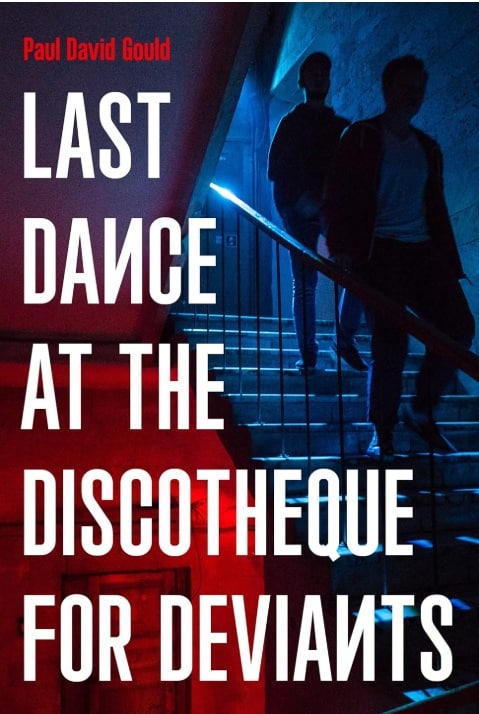
Paul David Gould’s recent novel Last Dance at the Discotheque for Deviants (2023) is set in the heady days of Moscow’s nascent gay scene of the 1990s. The title alludes to the first discos for “sexual minorities” [seks-men’shinstva] that sprang up at that time, or “discos for deviants” as Gould’s cast jokingly calls them. The narrative perspective switches between four viewpoint characters: Jamie, an out-and-proud British journalist who has come to Russia to seek a story and his fortune; the shy, artistic Kostya, tentatively emerging from the closet; Dima, the handsome stud who scrapes by through acting in adult videos; Tamara Borisovna, Kostya’s mother, a Soviet woman struggling to adapt to the changing world. Part coming-out story and part-thriller, the novel centers on the mystery behind the unexplained death of Kostya, last seen at the disco. Events unfold against the backdrop of the febrile 1990s, the economics of “shock therapy,” and the sudden influx of Western culture. The novel not only offers a fascinating account of Russian queer life at the time of transition, but also a meditation on the relationship between Russia and the West, and, more obliquely, an inquiry into how a (British) novelist can write ethically about the (Russian) Other.
Last Dance first captured my interest because of certain parallels with my own life. Like Jamie, I was a student of Russian, from the UK, who went on a study abroad program as part of my degree. While Jamie went to Voronezh in 1989–90, then still the Soviet Union, and I went to Krasnodar some fifteen years later in the Russian Federation, his experiences were familiar. I had to negotiate the same maze of when and how to come out, what words to use (our Russian language textbook didn’t cover this), and to navigate personal relationships. Like Jamie, I used the word “goluboi” the first time that I came out in Russia, imagining that it was somehow more authentically Russian than the anglicism “gei”, and I remember my interlocutor wincing at the word. Back then, my undergraduate institution offered no preparatory advice about how to handle these situations, but these days, I run a workshop for LGBTQ+ students and their allies prior to departure to discuss precisely these issues. My teaching increasingly includes an explicit focus on questions of positionality, as well as helping students make sense of their experiences abroad (these days, not in the Russian Federation, but in the Baltics, the Caucasus, or Central Asia). This approach means not only teaching the cultural contexts of gender and sexuality in these societies but also equipping the students with a critical awareness of their own worldview, assumptions, and biases, and thereby demonstrating all the complexities of a transnational, transcultural, and translingual encounter.
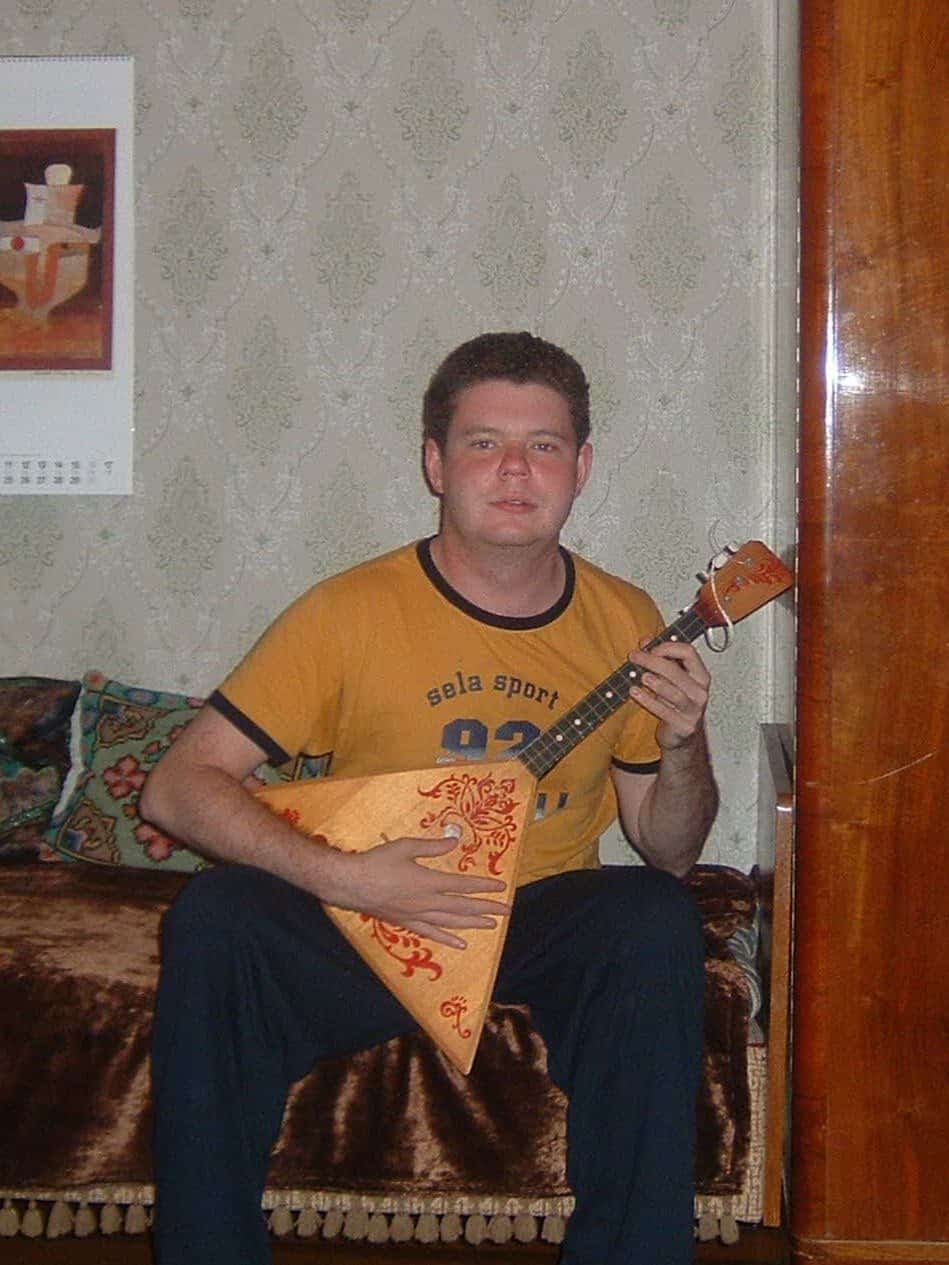
Last Dance offers an intriguing, close-up examination of such encounters and their manifold, unpredictable consequences. Gould challenges the familiar liberal trope of the enlightened, Western gay hero who rescues his repressed Russian counterpart, teaching him how to be a proud, global gay. Or, more accurately, Gould teases his readers by appearing to offer such a character in Jamie Goodier–whose very name suggests a desire to improve the world–but goes on to expose his hubris, even as the narrative shows some sympathy for his intentions. Shortly after arriving in Voronezh, Jamie strikes up a friendship with Kostya, who dreams of becoming an actor but is stuck working in the local theatre’s box office. Jamie immediately recognizes Kostya is gay, and, as the friendship cements, he urges Kostya to come out. On the one hand, the reader–this reader, I might say, recognizing my own positionality–longs to see Kostya accept his sexuality and get together with Jamie. Yet Jamie’s eagerness to see Kostya come out has as much to do with his own pride and self-interest as any genuine affection for Kostya. Jamie dresses to impress, loves watching “Kostya’s eyes running up and down him in what seemed like awe” and “smirks” as he sees the locals watch him with astonishment and envy. Jamie possesses a naïve arrogance in these early chapters, and there is something uncomfortably extractive in his attempts to collect stories of the privations of life in Russia so that he can “regale” his family and friends on his return. Yet Jamie does grow self-reflective throughout the novel, and his encounter with Kostya, though it never develops into a full-fledged relationship, proves crucial to this emerging self-awareness.
An explicit focus on questions of positionality…means not only teaching the cultural contexts of gender and sexuality but also equipping students with a critical awareness of their own worldview, assumptions, and biases.
I have written previously about the “queer transnational encounter” as a literary trope (Doak 2020). Often, discovering one’s own queerness is imagined not only in terms of physical attraction; there is also an acute sense of difference, which can translate into an estrangement from one’s own language, culture, and nation, and facilitate a whole host of transnational, transcultural, or translingual crossings. In post-Soviet Russia, queer sexualities have, of course, become associated with fears of Western decadence and immortality. The Putin regime in contemporary Russia has stitched together its populist “traditional values” agenda by stoking up a combination of anti-Western and homophobic sentiment (Edenborg 2018). In Last Dance, Kostya’s mother, Tamara Borisovna, predictably blames Jamie, “that English boy”, for her son’s homosexuality at first.
Yet long before the negative stereotype of Westerners seducing Russians into the LGBTQ+ movement, Russian literature treated queer transnational encounters in a more positive way. Indeed, a relationship between a Russian and an Englishman is at the heart of Mikhail Kuzmin’s Wings [Kryl’ia, 1906], which has been called “Russia’s first gay novel” (Moss 1997: 9) and even the “world’s first coming-out novel” (Ram 2011: 125). Vanya’s growing awareness of his own homosexuality has little to do with physical attraction to male bodies, but rather goes hand-in-hand with learning a new language (Ancient Greek), journeying abroad (to Italy), and a metaphysical awakening (he figuratively grows “wings”, giving the novel its title). Evgeny Bershtein has argued that Shtrup’s Englishness links him to fin-de-siècle Aestheticism (Walter Pater, John Addington Symonds, Oscar Wilde), the cult of Hellenism in their work, and their interest in the Greek model of homosexuality (Bershtein 2011).
In Last Dance, England does not represent an aesthetic ideal, but functions as a real place: a modern, diverse, capitalist society with all the opportunities and inequalities of the West today. Jamie is proud to come from Manchester, a city buzzing with fashion and music, and already home to a vibrant gay village in the 1990s, but Kostya visits him while he is at university in Birmingham. One of the novel’s most poignant passages involves Kostya’s first experience of a gay club during this trip. Kostya, now in love with Jamie, assumes that the two of them will spend the night dancing together. While Jamie does invite Kostya on to the dance floor, his roving eye is soon drawn elsewhere, and he vanishes into the crowd. Kostya feels betrayed when he eventually finds Jamie “sprawled, face-down, across a bench, on top of another boy.” The despairing Kostya leaves the club and wanders back to Jamie’s house alone through the January rain. By narrating this passage from Kostya’s perspective, the novel defamiliarizes the reader’s (this reader’s!) view of the gay scene. Far from a site of liberation or sexual discovery, the gay club for Kostya becomes a place of humiliation, a “market” where sex is commodified.

When I interviewed Gould, I asked him about the challenge of writing from the perspective of the four different viewpoint characters. The technique goes back to Faulkner and Woolf, but Gould named a more recent inspiration, Andrea Levy’s Small Island (2004), set among the British Caribbean community. In Gould’s novel, the method does not so much raise questions about the reliability of the four accounts, but it does expose vast differences between how the characters perceive and interpret events, as well as their own blind spots. Jamie’s arrogance and self-absorption becomes more obvious to us when we see it through Dima’s eyes. Viewed from Kostya’s perspective, Tamara Borisovna appears as an overbearing, conservative mother when seen from Kostya’s or Jamie’s viewpoint, but including her voice makes the reader understand—if not agree with—her actions. The narrative structure of Last Dance, then, forms a key part of the novel’s ethical framework, as it shows the limitations of any single narrative viewpoint, and what can be gained from intentionally adopting a perspective that is not one’s own. Gould’s attempt to inhabit the minds of his Russian characters should not be misunderstood as cultural appropriation. He approaches the task with sensitivity, avoiding any sense of Western cultural superiority, and regularly turns a critical eye on his own culture and himself.
If Last Dance models an ethical approach to writing Russia, it also shows examples of unethical writing. Jamie, as a young journalist, is all too eager to secure a big story about Russia that would launch his career. Jamie instrumentalizes Kostya’s death, seeing it as a vehicle for his big break. At one level, he realizes this: “A thought flashes across his mind: that it might be crass of him to turn his mate’s tragic death into a story … Straight away, he shakes off that thought. No, he’d be exposing a tragedy or, even worse, a cover-up. […] Who knows, an exclusive might help land him a job on the Moscow Times.” Jamie’s ability to switch off his own moral compass serves him well later: in the novel’s postscript, we see him working in 2014 as a news correspondent for Moscow World View (MWV), a TV channel bankrolled by the Kremlin in a thinly-veiled reference to RT. Jamie is redeemed, at least in part, by the final act in the novel, which is to use his position to go rogue and call out the homophobia of Putin’s Russia.
However, Gould’s critique of the gay scene extends to the rise of capitalism in 1990s Russia more broadly. Tamara Borisovna had enjoyed a stable job as a librarian in the Soviet period, but now finds herself stacking shelves in the Stockmann Department Store. One of the novel’s comic moments comes in her job interview: the question ‘‘Why should Stockmann employ you?’”, standard phrasing for those used to Western job interviews, leaves her stumped: “‘Oh, you don’t have to hire me,’ she’d replied, quite innocently, ‘not if you’ve got other people you’d prefer.’” More poignantly, her son, Kostya, also moves to work at a Western company: a (fictional) American organization called US-Care, supporting American business interests in the new Russia. The Director of US-Care is one Mario F. Waterson, a smooth American who keeps the top two buttons of his shirt open to show off “a glimpse of his suntanned chest”; it is hinted that he hires Kostya for his looks. Kostya, initially charmed by his new boss, is astonished when he sees his palatial condominium, and admits to wondering whether Moscow is being “colonized” by the Western elite. While Waterson is gay, an oversight on his part means that US Care has served to channel funding from American evangelical organizations to conversion therapy providers in Russia.
This plot twist proves crucial for events in the novel, but it also has real-world parallels. Recent research has revealed the extent to which transnational networks have been responsible for the spread of anti-LGBTQ+ ideology in Russia and elsewhere (Stoeckl and Uzlaner 2022). American “family values” organizations collaborated with conservative groups in post-Soviet Russia to promote neotraditional norms of gender and sexuality and oppose LGBTQ+ rights (Stoeckel 2020). One might call these connections “queer transnational encounters” in a different sense, where the narrative does not involve a Westerner seducing a Russian into homosexual activity, but rather into neo-traditional and anti-gay values. Talia Kollek (Kollek 2025) has shown how Russia’s contemporary transphobic policies, while rhetorically aimed against the bogeyman of Western liberalism, in fact draw on transphobic discourse imported from the West. And the reverse is now happening as well, as Americans are attracted by the “allure” of far-right Russian Orthodoxy, admiring Russia as “a revived traditionalist nation, against the modernity of the United States” (Riccardi-Swartz 2021).
Last Dance offers a powerful reminder that Putin’s Russia was not inevitable.
Putin’s neotraditional Russia features in Last Dance only in the postscript, set in 2014, at the time of the controversy around Russia hosting the Sochi Olympics despite having passed the first version of the anti-gay law in 2013. The postscript updates us on the fate of the characters. Jamie, as already has been mentioned, has been working for a Kremlin-funded media outlet, but finally breaks away from the quest for a “story” to speak his own truth. Dima is living in Latvia: he had grown up in the Latvian SSR as an ethnic Russian, and, on his return, started learning Latvian and is now living with Aivars. This is another example of a queer relationship that transcends boundaries of language and ethnicity. Dima has set up a support group for gay men, trying to build a kinder community than what we saw in both England and Russia in the 1990s. Tamara Borisovna has perhaps undergone the greatest journey: back in Voronezh, she is supporting a young gay man who has been kicked out by his parents, and, after a homophobic attack, fashions a rainbow flag to fly from her balcony in defiance of the government.
Last Dance offers a powerful reminder that Putin’s Russia was not inevitable. The current regime has created a myth of the 1990s as a period of national weakness, economic chaos, and cultural collapse in order to legitimize the authoritarian turn under Putin (Kalinin 2023). Last Dance does not hide the privations of the 1990s, the magnitude of the culture shock that accompanied the fall of the Soviet Union, nor the moral turpitude that often lay behind Westernization. However, the novel suggests a different response might have been possible. Last Dance looks to alternative forms of community, based on collective responsibility and a mutual ethics of care, which might have led to a different outcome for Kostya, and, it is implied, for Russia as a whole. Such an approach could have addressed the structural inequalities of capitalism without resorting to repressive government, “neo-traditional values”, or scapegoating the LGBTQ+ movement.
This semester, I plan to teach Last Dance in my advanced undergraduate course, “Russia and the World, 1991–present.” My hope is that the novel will not only help students make sense of their own experiences and encounters while studying abroad, but also encourage them to think critically about their own positionality as students of languages and cultures, and what it means to write ethically about the Other. Even among researchers, our field has been slow to accept the emphasis on positionality that has been mainstream in anthropology for some years now. I do not mean to suggest a crude model that insists one can only write legitimately about one’s own in-group; Gould’s book is evidence that the opposite is true. Last Dance also offers a vindication of imaginative literature, and specifically the novel, as a vehicle for asking big questions about the state of the world, and daring to offer moral instruction, though of a different sort from Putin’s. In this sense, this queer book really is a thoroughly Russian novel, in the best sense of that word.

Connor Doak is senior lecturer in Russian at the University of Bristol. He has recently edited a special issue of AvtobiografiЯ on “Queer Life Writing in Russia and Beyond” (2022). Together with Andy Byford and Stephen Hutchings, he co-edited “Russian and Slavonic Studies at the Crossroads” in Forum for Modern Language Studies (2024), and the book Transnational Russian Studies (2020). He has published on gender and sexuality in Russian literature including Pushkin, Dostoevskii, Chekhov, and is currently working on a monograph on Maiakovskii and masculinity.
Paul David Gould will be in conversation with Connor Doak on Monday, November 3, 2025, at 6pm GMT / 1pm EST. This hybrid event will be held at the University of Bristol and online: please email [email protected] if you wish to register.