2025 was a challenging year for ASEEES, due to many external factors beyond the control of the organization, but we rose to meet those challenges to the best of our abilities. Our membership numbers remained high; we held a successful, well-attended annual convention in Washington, D.C.; we launched a new fundraising campaign to provide dissertation research fellowships and grants; we increased funding for existing grant programs; and we advocated strongly for the field, international education, and federal funding.
Membership
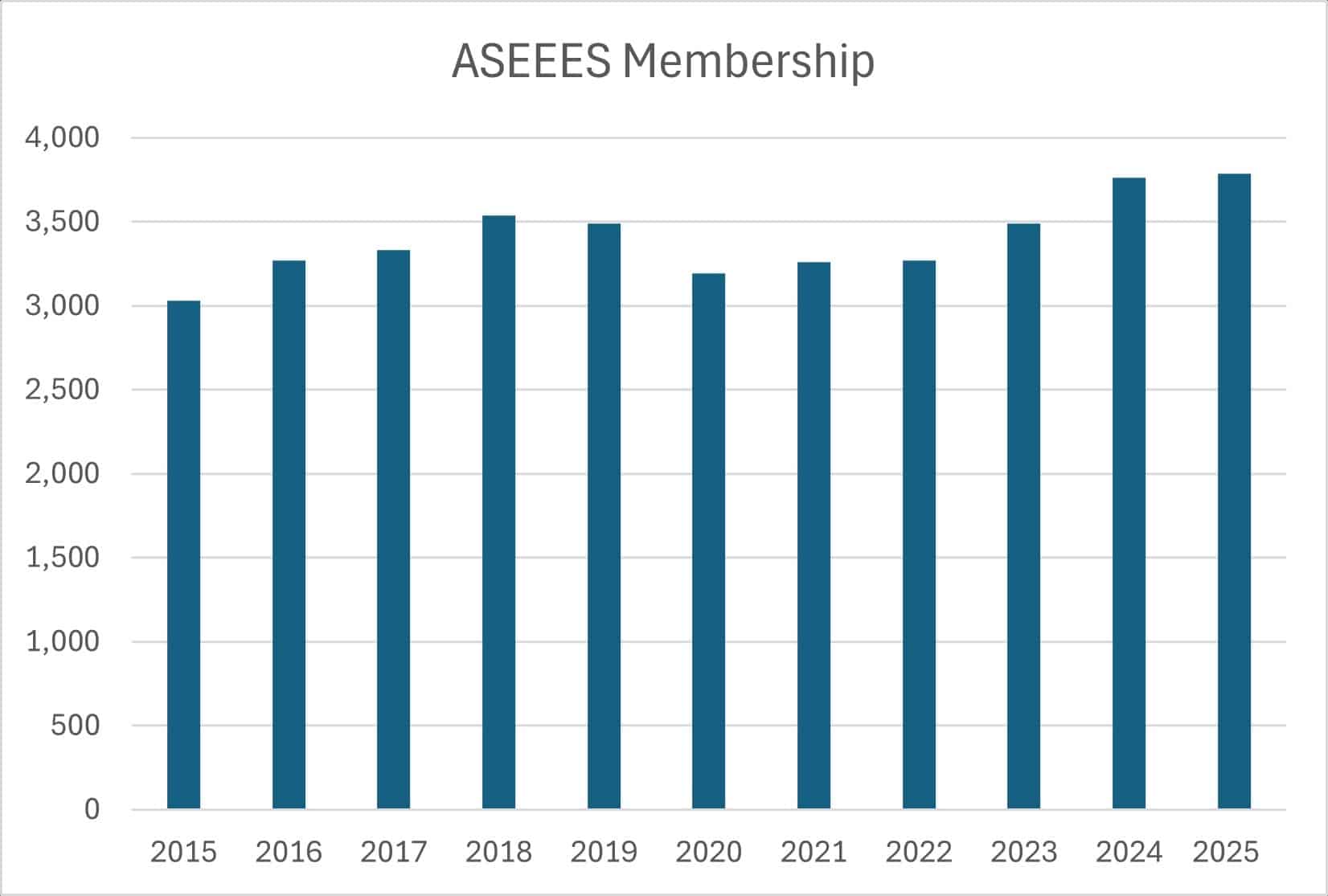
The 2025 individual membership numbers exceeded the 2024 numbers, which was already a significant increase from the previous years.In 2025, we had 3,785 members (compared to 3,764 in 2024): 848 student members (a 7.3% increase from 2024 and representing 22.4% of total members); 295 affiliate members (7.8%); and 105 lifetime members (2.7%). We had 1,289 international members (34.1% of total members) from 57 countries, of which 509 are from countries in Eastern Europe and Eurasia. 160 of 509 from the region were received membership at the reduced rate; 86 scholars in Ukraine or displaced due to the war were given complimentary memberships. We had 49 institutional members: 22 premium and 27 regular members. For trends in membership over the last decade, please see the table appended to this report.
Annual Convention
The 57th Annual Convention was held at the Washington Hilton on November 20-23, 2025, with a smaller virtual convention held on October 23-24. With the annual theme “Memory,” the convention program offered 665 sessions (435 panels, 207 roundtable, 23 individual paper panels/lightning rounds), 6 film screenings, 18 receptions, 26 affiliate group meetings, and 5 literary events and performances, including a performance by the Silk Road Dance Company. 595 sessions were for the in-person convention while 70 were for the virtual convention. 158 sessions included the word “memory” in the session title; 68 sessions were marked for the Spotlight on Central Asian Studies. The 2025 ASEEES President Adrienne Edgar (UC Santa Barbara) gave her presidential address, “Scholarship and Shattered Illusions,”and organized and chaired the timely Presidential Plenary on “How Can the Field of Slavic, East European, and Eurasian Studies Help Us to Understand the Current Moment?” featuring Stephen Hanson (College of William & Mary); Togzhan Kassenova (SUNY Albany); Jan Kubik (Rutgers, The State U of New Jersey/U College London); Benjamin Nathans (U of Pennsylvania); and Gulnaz Sharafutdinova (King’s College London). I thank the Program Committee for its efforts on the convention program. I especially thank Committee Chair Sarah Cameron (U of Maryland) for her tremendous work in managing the committee, scheduling the huge number of sessions, and addressing unexpected issues that arose in this challenging time.
The final registration numbers were as follows: 2,928 registrants, consisting of 2,669 for in-person+virtual (91%) and 259 for virtual only (9%) – 2,551 registrants were ASEEES members (87%); 649 were first-time attendees (22%); 551 were students (19%). Of the 887 international registrants (30%) from 53 countries, the largest contingents were from the UK (112), Germany (112), and Canada (94). We offered complimentary registrations to 75 participants from Ukraine or who were displaced from Ukraine. We thank the 15 sponsors, 47 exhibitors, and 18 advertisers for their support.
The 58th Annual Convention will be held at the Palmer House Hilton in Chicago on November 12-15, 2026, with a virtual convention scheduled for October 16-17. The theme is “Nations and Empires,” and the convention will spotlight Balkan Studies. Karen Evans-Romaine (U of Wisconsin Madison) will chair the Program Committee.
External Challenges in 2025
Since late January, many external conditions, particularly due to the policies of the current US administration, led to uncertainties and challenges. Many federal funding programs for the field were paused or placed in precarious positions. We saw worries about travel to the US for international attendees to the convention, anger from our Canadian members regarding the US policies vis-à-vis Canada, and loss or reduction of research/conference travel funding for US members. The Board held a special meeting in April and issued the Board Letter to the Members in May. In June, the Ministry of Justice of the Russian Federation declared ASEEES an “undesirable organization.” We at ASEEES developed a contingency plan for the convention, with the goal of remaining flexible and accommodating the convention participants as much as possible. We offered additional funding for convention travel grants and dissertation grants. We hosted regular meetings for our institutional affiliates who are recipients of Title VI and Title VIII grants to share information, resources, and advocacy efforts, and issued advocacy statements in support of federal funding and for university programs and signed joint statements in solidarity with other organizations.
Status of Relevant Federal Funding and Programs (as of December 2025)
While it is difficult to provide a clear information on federal funding after the chaotic year with constant changes, below is a status update on some of the most relevant funding programs.
- The Title VI/FLAS Program (Department of Education) is in serious jeopardy. In the spring of 2025, the office at the Department of Education that administered the program was closed down and the staff fired; the Title VI program was moved to the Higher Education Program (HEP) office and assigned new program officers. On September 10, the Title VI-funded National Resource Centers (NRC) received a sudden letter notifying them of “non-continuation” of Title VI/FLAS grants for the current year 2025-2026, impacting the current academic year and summer 2026, although the funds were allocated in the Continuing Resolution that Congress passed in March 2025. NRCs were given 7 days to submit a reconsideration letter, which most did to no avail. ASEEES, along with other organizations in the Coalition for International Education, submitted a joint letter of appeal to the Secretary of Education. For the current academic year, most of the universities are providing some support to maintain the centers’ programs, and the centers that had funding left over from previous years have been able to offer some FLAS fellowships, but many students lost their FLAS fellowships.
The bigger concern is the viability of the 4-year grant competition that should be held in 2026. The FY2026 federal budget is very much up in the air. The Title VI funding is in the Senate budget but not in the House budget at all. If the Department of Education does not hold the 4-year Title VI/FLAs grant competition in 2026, that would put in jeopardy the whole National Resource Center/FLAS infrastructure that the US government and partnering universities took decades to build.
- The Title VIII Program (Department of State) that provides funding for advanced research and summer language programs still exists, at least on paper. The program was first swept up in the State Department’s pause of all foreign assistance programs, although Title VIII is not a “foreign assistance” program. Then the grantees received termination letters, which were soon followed by lifting of suspension letters. In August, the Title VIII program’s administrative functions were moved from the Bureau of Intelligence and Research (INR) to the Bureau of European and Eurasian Affairs, Office of the Coordinator of U.S. Assistance to Europe, Eurasia, and Central Asia (EUR/ACE) and assigned to new staff. We see this as a positive sign. We are hopeful that the new office in charge of the program will run the 2026 grant competition.
- There are other federal programs, particularly through the Department of Defense, with relevance for our field. The Flagship Language program is still running, but Project Go appears to be paused.
- The Fulbright Program (Department of State/IIE), is similarly in a limbo state, even for FY2025 budget. OMB initially planned to cut funding for it, but it is my understanding that the funding was received. The President’s Budget for FY2026 calls for a 93% funding cut to the Department of State ECA, which funds Fulbright. This site is a useful resource to keep track of the program status.
- The NEH has been dramatically reduced, and its existing grants were withdrawn earlier in 2025. Although we initially thought the NEH would be shut down, they opened new grant competitions: thus far, these calls have mainly focused on the current administration’s mandates.
- On a positive note, on November 10, 2025, the Kennan Institute announced its return as a private institution, no longer tied to the Woodrow Wilson Center.
Advocacy
In 2025, ASEEES issued and signed numerous advocacy statements related to the US federal government’s actions and funding cuts as well as threats of program cuts and changes at universities. ASEEES also signed the American Historical Association’s amicus brief in support of Harvard University’s lawsuit against the federal government over the university’s ability to host foreign scholars and students. The list of statements and action alerts is on the ASEEES website.
Fundraising
For FY2025 that ended on June 30, 2025, we received $312,976 in donations and pledges, including: $176,000 for the Cohen-Tucker Dissertation Fellowships; an $18,000 multi-year pledge for the Bradley-Ruane Research Grant; a $24,000 multi-year pledge for Women’s Gender, and Sexuality Studies Grant; a $6,000 pledge for the Ukrainian Studies Grant; $10,000 for the Regional Scholar travel grants; and $4,150 for childcare grants.
For FY2026, with the aim of mitigating the loss of federal research funding for PhD students in the US, in August we launched the Next Generation Emergency Research Support Fund campaign with the ambitious goal of raising $400,000 to provide 12 $28,000 fellowships and 10 additional $6,000 Dissertation Research Grants in 2026, 2027, and 2028. Initiated and led by 2025 ASEEES President Adrienne Edgar, the Campaign Leadership Committee have worked tirelessly in asking prospective donors to give to the campaign. We are delighted to report that as of January 6, 2026, we have raised $405,000, exceeding our initial goal. We have now increased the campaign goal to $450,000 to provide more fellowships and grants. We thank the Campaign Leadership Committee members: Adrienne Edgar (UC Santa Barbara), Chair; Harley Balzer (Georgetown U); Mark Beissinger (Princeton U); Alexandra Birch (Columbia U); Edith Clowes (U of Virginia); Laura Engelstein (Yale U); Stephen Hanson (College of William & Mary); Tsuyoshi Hasegawa (UC Santa Barbara); Adeeb Khalid (Carleton College); Adele Lindenmeyr (Villanova U); Virginia Olmsted-McGraw (US Naval Academy); Daniel Orlovsky (Southern Methodist U); Lewis Siegelbaum (Michigan State U); Robert Weinberg (Swarthmore College); Kimberly Zarecor (Iowa State U).
Convention Grants
For the 2025 Annual Convention in Washington, D.C., we received an exceptionally large number of grant applications. With the Board-approved allocation of additional funds, we awarded 108 travel grants for a total of $67,540.
- 53 Graduate Student Travel Grants (31 students at US institutions and 22 at non-US institutions, including citizens of 16 different countries);
- 33 Regional Scholar Travel Grants;
- 15 Convention Opportunity Travel Grants;
- 7 Convention Inclusion Travel Grants.
We also awarded 29 childcare grants for a total of $7,025. This is the second year of the childcare grant program.
Fellowships and Grants
In the calendar year of 2025, we awarded 46 fellowships and grants, totaling $380,000. This included Board-approved allocation of additional funds for 4 Dissertation Research Grants and 4 Summer Dissertation Writing Grants.
- 12 Dissertation Research Grants, up to $6,000 each, including the Dissertation Research Grant in Women and Gender Studies, the Maya K. Peterson Dissertation Research Grant in Environmental Studies, the Joseph Bradley and Christine Ruane Dissertation Research Grant in Russian Studies, the Dissertation Research Grant in LGBTQ Studies, and the James Bailey Dissertation Research Grant in Folklore Studies;
- 14 Summer Dissertation Writing Grants, up to $6,000 each;
- 4 Cohen-Tucker Dissertation Research Fellowships, up to $28,000 each;
- 2 Cohen-Tucker Dissertation Completion Fellowships, up to $28,000 each;
- 9 Internship Grants, with a monthly stipend of $2,000;
- 5 First Book Subventions, up to $2,500 each.
In 2026, we anticipate offering fellowships and grants totaling $474,000, including the Next Generation Dissertation Research Fellowships and additional Dissertation Research Grants, made possible by the Next Generation Emergency Research Support Fund campaign.
ASEEES Prizes
ASEEES conferred 14 prizes and awards to 29 awardees and honorable mentions, including the Distinguished Contributions to Slavic, East European, and Eurasian Studies Award honoree Edith Clowes (U of Virginia), at the 2025 Annual Convention.
Slavic Review
We are in the second year of the five-year contract for 2024-2028 with Cambridge University Press (CUP) to publish Slavic Review. Starting with the 2024 volume, Slavic Review has become mainly a digital journal with a limited number of print copies being available to members at an additional cost. Slavic Review remains the premier journal in the field, receiving an exceptionally large number of article submissions. Under the editorship of Eugene Avrutin, the journal is publishing forums and clusters on innovative topics and research. It also launched the FirstView feature on the Cambridge Core platform to ensure timely access to the latest research.
Professional Development Programs
In the fall of 2024, ASEEES launched its Managing Mid-Career Milestones initiative, hosting two interdisciplinary panel discussions exploring big picture questions and practical strategies for success in mid-career. Topics included the considerations surrounding taking on administrative roles, challenges and opportunities relating to second book projects, and strategies for balancing teaching and research. In spring 2025, we facilitated a six-week structured accountability group, fostering a supportive environment for setting and achieving professional goals pertaining to the mid-career through weekly check-ins. In 2025, we continued our Research Meetup Series. These informal events offer scholars of a common ‘sub-region’ an opportunity to discuss the practicalities of doing onsite research in a given area. In the spring, we held two meetups, one on doing research in Poland, Hungary, and Slovakia and the other on doing research on Romania, Bulgaria, and Hungary. In the fall, we held a meetup on doing research on Russia outside of Russia. Additionally, we held a two-part virtual roundtable series on Navigating SEEES Collections in 2025, featuring librarians representing collections in the U.S. and beyond. The first roundtable focused on researching Russia in 2025 – collections, resources, and challenges, and the second one covered the changing landscape of library collections for scholars of SEEES. The second session was recorded and made available to members via our Webinar Archive.
Career Webinars: In spring 2025, ASEEES held a two-part virtual panel series on Careers Beyond Academia for members interested in broadening their career trajectories, featuring SEEES professionals who spoke on careers in K-12 education and museums and curation. These events were recorded and are available on the ASEEES YouTube channel.
We made 31 junior contact/senior contact matches as part of the ASEEES Mentoring Program in 2025.
Board Election
In May 2025, the Nominating Committee proposed the following slate for the 2025 Board elections: Edith Clowes (Slavic, U of Virginia) and David Cooper (Slavic, U of Illinois at Urbana-Champaign) for President-Elect/Vice President; Molly Brunson (Slavic, Yale U), Emily Greble (History, Vanderbilt U), Christopher Hartwell (International Business Policy, Zurich University of Applied Sciences), and Alexis Peri (History, Boston U) for the two Member-at-Large positions; and Nikoloz Nadirashvili (Art History, U of Washington) and Graham Weaver (Comparative Literature, NYU) for the Graduate Student Representative seat. The vote was held online from mid-June to September 1, and the results were the following: David Cooper was elected Vice President/President-Elect 2026 (service on the board 2026-2028); Emily Greble and Alexis Peri were elected Members-at-Large for 2026-2028; and Nikoloz Nadirashvili was elected the Graduate Student Representative for 2026-2027. 3,503 ballots were sent, and 1,356 votes were received, for a total response rate of 38.7%. The other incoming Board members in 2026 are: Alicia Baca (Ohio State U) as the Council of Regional Affiliates representative; Jeffrey Hass (U of Richmond) as the Sociology representative; Thomas Keenan (Princeton U) as the CLIR representative; and Victor Petrov (U of Tennessee, Knoxville) as the AHA representative.
I thank the ASEEES staff, Jenn Legler, Margaret Manges, Leah Valtin-Erwin, and Roxana Espinoza, for their assistance in preparing this report and for their tremendous work, particularly in finding solutions for myriad unexpected challenges.
I also express my gratitude to the ASEEES Board, especially the outgoing 2025 Board members for their service: Vitaly Chernetsky, Anna Arays, Cynthia Buckley, Kristen Ghodsee, Krista Goff, Sharon Kowalsky, Alison Smith, and Brian Yang.
Finally, I thank the University of Pittsburgh for hosting the main ASEEES office and the University of Illinois Urbana-Champaign for hosting the Slavic Review editorial office.