

Marina Alexandrova
Senior Lecturer in Russian Studies, Department of Slavic and Eurasian Studies, University of Texas at Austin
When did you first develop an interest in Slavic, East European and Eurasian Studies?
My interest in Slavic, European and Eurasian Studies began at the first lecture I attended on the history of Russian literature during my first semester at Saratov State University. The professor solemnly proclaimed that “The Tale of Bygone Years soars like a majestic cathedral above the terrain of Russian literature,” and that image left an indelible mark on my imagination. Little did I know that in time I would lead students through the same chronicle in my “Advanced Russian through History” course at the University of Texas at Austin. Writing my dissertation on a Russian avant-garde literary group, the Serapion Brothers, solidified my commitment to the field of SEEES, and piqued my interest in networks of knowledge and the Russian public sphere.
What support have you received throughout your career (from ASEEES/other societies/federal support/etc.) that has allowed you to advance your scholarship?
I was fortunate that my academic work was supported by my home institution, initially with awards from the Hutchison Endowment Fellowship and the McIlhany Endowed Presidential Fellowship, excellence and dissertation completion fellowships awarded by the University of Texas at Austin, and later through professional development awards from the Texas Language Center. More recently, I have benefited from several course development grants and teaching awards, including a grant from the Experiential Learning Initiative to study and put into practice drama based pedagogy. On the federal level, I was the recipient of a FLAS fellowship.
What is your current research/work project?
 Currently I am working on an article that links Konkordia Antarova’s lengthy novel Two Lives, allegedly written as a result of clairaudience, with Helena Blavatsky’s reliance on the teachings of certain mysterious Masters, or Mahatmas. This style of knowledge channeling, pioneered by Blavatsky and widely practiced by Theosophists and members of other esoteric movements, became an important means of community making for underground esoteric groups in the Soviet Union. My current monograph locates Helena Blavatsky’s writings within the radically different religious landscapes of Russia and the United States. Since I believe that research and teaching are two sides of the same coin, I enjoy working through these and related issues of Russian spirituality in my flagship course, “Tsars and Mystics.”
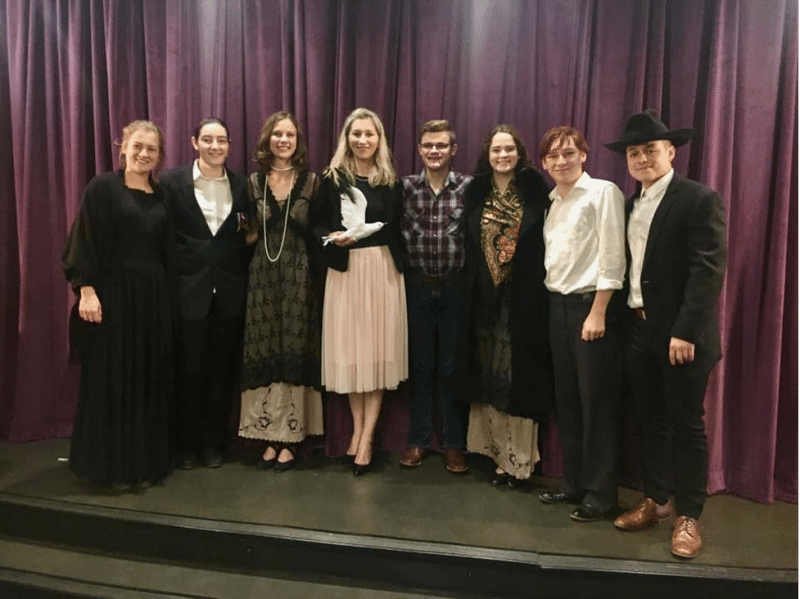
My appreciation for Russian theater inspired me to use drama to teach advanced Russian. In 2018, we staged Mayakovsky’s provocative play Bedbug (1930). We decided to attempt an even more challenging production in 2019, when I staged Chekhov’s Seagull with a group of undergraduate and graduate students. My next project will likely be a production of Chekhov’s Uncle Vanya.
What does your ASEEES membership mean to you? How has your involvement with ASEEES helped to further your career?
My ASEEES membership has given a tremendous boost to my career. For example, the connections I made in 2019 at the panels on esoteric thought and New Age movements in Russia opened up various professional opportunities, including participation in the German-Russian Research Project on New Age in late Soviet and post-Soviet Russia, publication of a research blog and other ongoing projects. As an Undergraduate Research Mentor, I was very excited to introduce my research assistant to the world of academic conferences through the well-organized and intellectually stimulating ASEEES convention.
How do you envision your current research projects(s) within the broader field of SEEES?
My ongoing research contributes to our understanding of both Russian history and the depth and diversity of spiritual traditions in Russia. I am committed to making such contributions not only to the scholarly world in articles, books and other academic outlets, but to the general public as well. To this end I have contributed my expertise on the Romanovs in the docudrama The Last Czars (2019), currently streaming on Netflix and BBC Mundo.
Besides your professional work, what other interests and/or hobbies do you enjoy?
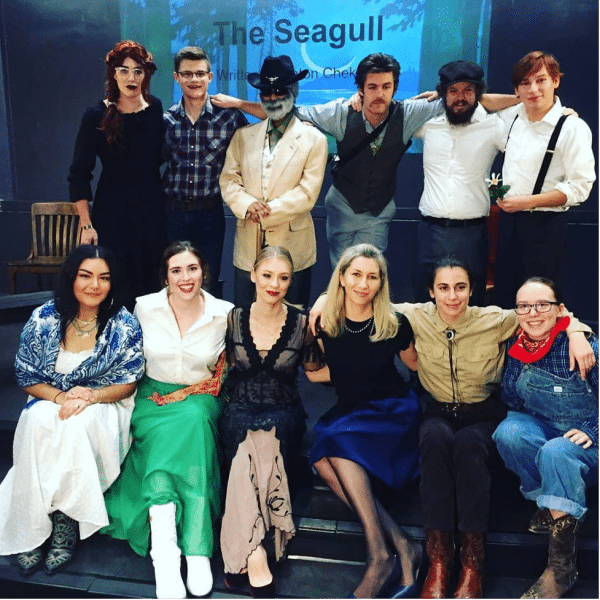 My interests and hobbies have a way of becoming my professional endeavors, and vice versa. For instance, while watching Uncle Vanya at Harold Pinter Theatre a year ago, I caught myself thinking how we could adapt this play for the next “Advanced Russian through Drama” performance. Even my personal interest in yoga recently turned into a new project that examines the spread of yogic theory and practice in Russia.
My love of travel also became a professional experience last year, when I taught two graduate seminars at the Université Paris Nanterre as part of a faculty exchange program at UT-Austin.