
2025 Recipient
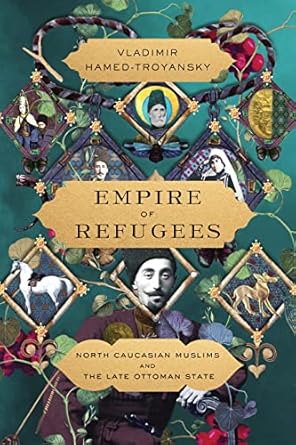
Vladimir Hamed-Troyansky
Empire of Refugees: North Caucasian Muslims and the Late Ottoman State
The Barbara Jelavich Book Prize, established in 1995 and sponsored by the Jelavich estate, is awarded annually for a distinguished monograph published on any aspect of Southeast European or Habsburg Studies since 1600, or nineteenth and twentieth century Ottoman or Russian diplomatic history in the previous calendar year.
Winner: Vladimir Hamed-Troyansky, Empire of Refugees: North Caucasian Muslims and the Late Ottoman State (Stanford University Press, 2024)
Hamed-Troyansky presents an impeccably researched study that spans multiple geographies, languages, and archives, tracing the mass migration of North Caucasian Muslims to the Ottoman Empire from the 1850s through World War I. Connecting the different parts of the Jelavich call—Russian/Ottoman nineteenth-century history and Balkan Studies—the book challenges the idea that geographies are neatly divided and invites us to think about original connections between different places and communities, as refugees migrated across them in the late nineteenth century.
Drawing on Ottoman Turkish, Arabic, Russian, and Bulgarian sources, including petitions from refugees and oral histories from their descendants in Jordan and Turkey, the book makes a bold argument that the Ottoman refugee regime served as a precursor to modern humanitarian systems. The work’s methodological sophistication is noteworthy, weaving together imperial biopolitics, business history, and intimate microhistories while operating across multiple scales with remarkable effectiveness.
The author humanizes historical actors, showing how Circassians and Tatars actively shaped their migration processes, brought their legal traditions and social norms to new places, and developed new identities through this often tense process. Simultaneously, the book demonstrates how refugees transformed Ottoman state structures, prompting the creation of complex bureaucratic frameworks and new laws that would influence Middle Eastern societies and international refugee law for decades.
By connecting the Islamic concept of hijra to refugee studies and revealing how migrants created interconnected spaces across Ottoman imperial lands, this paradigm-shifting work promises to transform multiple fields while resonating with contemporary migration issues.
Winner: Katya Motyl
Prize Committee: Vladimir Kulić (chair), Emily Greble, and Elidor Mëhilli