
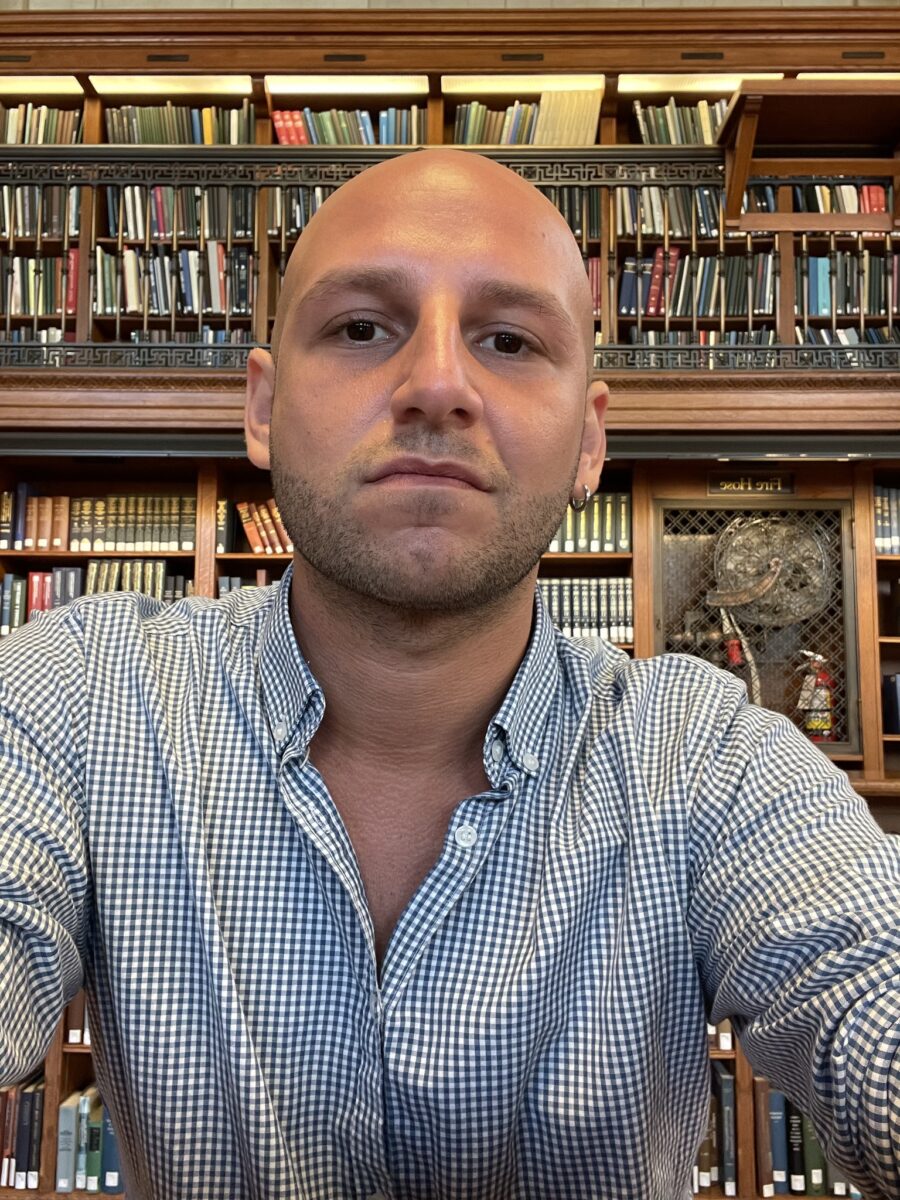
Nikoloz Nadirashvili
Graduate Student Representative Candidate
Nikoloz Nadirashvili is a Ph.D. student in Art History at the University of Washington. His research focuses on late Soviet (1975–1990) and post-Soviet artistic practices that incorporate religious content in Georgia, Ukraine, and Russia. While centered on the Black Sea region, his work has a transnational dimension: he seeks to develop a comparative, transhistorical analysis that includes the Estado Novo—Portugal’s 20th-century Catholic authoritarian regime.
From 2019 to 2022, Nadirashvili served as a UNESCO expert, contributing to the development of state and municipal support mechanisms for the cultural and non-governmental sectors in Georgia. His work responded to the rise of pro-Russian authoritarian political ideology. Since 2012, he has been a vocal critic of Bidzina Ivanishvili’s oligarchic regime, expressing his dissent through public commentary and critical writing on art.
As a co-founder of the Contemporary Art Archive, he managed a bilingual platform that documents and analyzes the legacy of Georgian contemporary art through multimedia content. At the University of Washington, he continues his engagement with Digital Humanities (DH), co-organizing the DH Cluster and connecting his art historical research with socio-political data.
In addition to his scholarly and political work, Nadirashvili has curated several contemporary art exhibitions. His curatorial practice challenges the esoteric and elitist tendencies of the contemporary art world, emphasizing bold research frameworks and broader accessibility. His upcoming group exhibition, The End is Fear, will take place in Seattle in 2026 and will feature five Portuguese artists whose work critiques the principles of the Estado Novo regime.
If elected as Graduate Student Representative, Nadirashvili would work to strengthen transnational collaborative practices beyond the framework of the annual conventions. He would propose and support initiatives that enable scholars—especially students and independent researchers from ASEEES-covered regions—to connect and collaborate with U.S.-based scholars throughout the year. Additionally, he would advocate for policies that encourage the formation of panels that deliberately mix emerging and established scholars.