
Monday, June 02, 2025
Kim Yehbohn Lacey
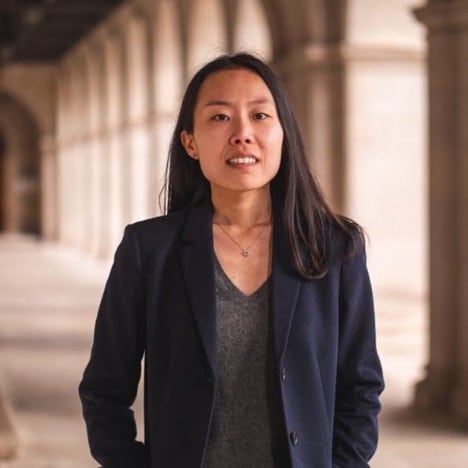
Kim Yehbohn Lacey is a Ph.D. Candidate and Korea Foundation Scholar at Washington University in St. Louis.
When did you first develop an interest in Slavic, East European, and Eurasian Studies?
I was born and raised in South Korea but spent quite monotonous teenage years in a small town in Texas without much diversity or excitement. By the time I got to Bowdoin College, a small liberal arts college in Maine, I was eager for a change and saw endless opportunities to explore my intellectual curiosity. One of the things I spontaneously did with my roommate in the first week of class was to sign up for Russian 101, which appeared to be the most challenging and “mysterious” language course. The instructor (Jane Knox) was a kind, hilarious, and a bit eccentric woman in her seventies who was extremely passionate and knowledgeable about the Russian language and culture. I ended up taking various courses outside of language study, including Soviet cinema, Russian literature, and politics. During my junior year, I spent a summer in Kazan as part of the Critical Language Scholarship program, followed by a full academic year in Moscow, which opened up a whole new world for me.
How have your interests changed since your initial interest in the field?
Right after college, I worked in Japan for two years as a Coordinator for International Relations as part of the JET Program. I was placed in a city called Asahikawa in Hokkaido, the northernmost prefecture of Japan, with a rich and intriguing history. Due to Hokkaido’s proximity to the Russian Far East, there has been significant movement of people and goods. Some of Asahikawa’s sister cities were Yuzhno-Sakhalinsk and Harbin. I did not fully realize it at the time, but this was when I began to develop a deep interest in Russian/Soviet history in the so-called peripheries in the Far East and the rivalry with Japan. For example, I began delving into the history of Karafuto/Sakhalin and the tragic fate of the Koreans who were stranded on the island after WWII. Upon returning to the U.S., I enrolled in an MA program in international relations at the University of Chicago to study these regional dynamics further, then decided to pursue a Ph.D. in history. My doctoral dissertation examines the lives of Koreitsy, ethnic Koreans in the former Soviet Republics, whose history reveals the consequences of empires, colonialism, and regional conflicts over time.
Tell us about your most interesting/enjoyable research or work experience.
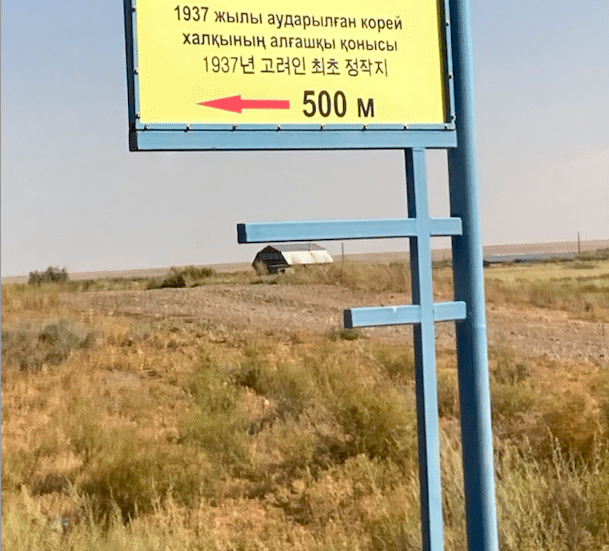
I spent 18 months conducting archival and field work in six different countries in 2022-24. Because of Russia’s full-scale invasion of Ukraine that same year, I had to constantly adjust my travel plans. This uncertainty was not only frustrating but also mentally and physically exhausting . Fortunately, I received support from several fellowships and grants, including the Cohen-Tucker Dissertation Research Fellowship, the Title VIII Research Grant, and the Fulbright-Hays DDRA Fellowship, which helped me maintain focus on the project. The most challenging and rewarding part of my research was getting to know the people during my ethnographic work. I met hundreds of ethnic Koreans across Eurasia (especially in Central Asia) and conducted in-depth interviews. It took courage, patience, and effort to gain the trust of the people and the community. There were times when I faced cold and skeptical responses, but most welcomed me warmly and treated me as if I were their own daughter and granddaughter. I am deeply indebted to those who took the time to share their family histories and personal collections, which often provided missing pieces from my archival work. I hope to share these stories through my dissertation and monograph in the future.
What do you value about your ASEEES membership?
Ever since I attended my first ASEEES convention in New Orleans in 2021, I have found the annual convention to be a productive and engaging venue for exchanging ideas and getting to know different scholars from various disciplines at all levels. I also appreciate the efforts that the organization has been making to increase diversity and inclusivity through various initiatives which I took part in, such as mentorship opportunities, casual online get-togethers, and conference travel support.