
2025 Recipient
Karen Underhill
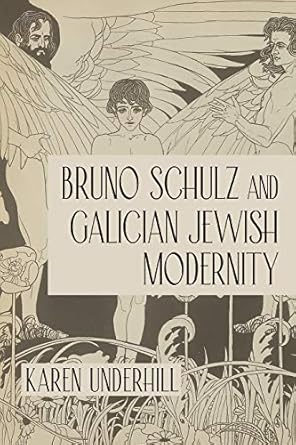
Bruno Schulz and Galician Jewish Modernity
The Kulczycki Book Prize in Polish Studies (formerly the Orbis Book Prize), established in 1996 and sponsored by the Kulczycki family, former owners of the Orbis Books Ltd. of London, England, is awarded annually for the best book in any discipline, on any aspect of Polish affairs, published in the previous calendar year.
Winner: Karen Underhill, Bruno Schulz and Galician Jewish Modernity (Indiana University Press, 2024)
In Bruno Schulz and Galician Jewish Modernity, Karen Underhill presents a brilliantly original and deeply researched new contextualization of the works of Polish Jewish writer and artist Bruno Schulz (1892–1942). Underhill convincingly argues that Schulz was engaged in an explicitly Jewish modernist project in the Polish language, producing a unique messianic poetics in secular form as a response to Jewish diasporic experience. In this sense, Underhill contends, Schulz was part of a wider Central and Eastern European “diasporic cultural renaissance” that also included such figures as Franz Kafka, the philosopher Martin Buber, and the Yiddish poet Itzik Manger. Underhill builds her arguments on the basis of the most recent archival discoveries, including Schulz’s rediscovered essay on the Jewish artist Ephraim Moses Lilien, in which he lays out some of his key ideas on diasporic creation. Underhill combines her interpretations of these theoretical excursuses with wide-ranging comparative analyses, demonstrating a masterful command of an extraordinary range of sources in Polish, Yiddish, and German. In this way, she situates Schulz deeply in diverse cultural contexts, both local and transcultural. She also delivers a set of highly original close readings of various literary texts and images by Schulz, revealing how Schulz embodied his exilic ideas in his artistic work. Underhill weaves together these different dimensions of her argument into a highly convincing and coherent overall interpretation of both Schulz and his milieu. Underhill’s work combines the skills of a literary scholar and cultural historian to produce a scholarly work of stunning freshness and insight. She makes outstanding contributions to both Polish studies and Jewish studies, presenting a leading modernist writer and artist of Central and Eastern Europe in a thoroughly new light.
Honorable Mention: Agnieszka Pasieka
Prize Committee: Stanley Bill (chair), Anna Cichopek-Gajraj, and Kyrill Kunakhovich