
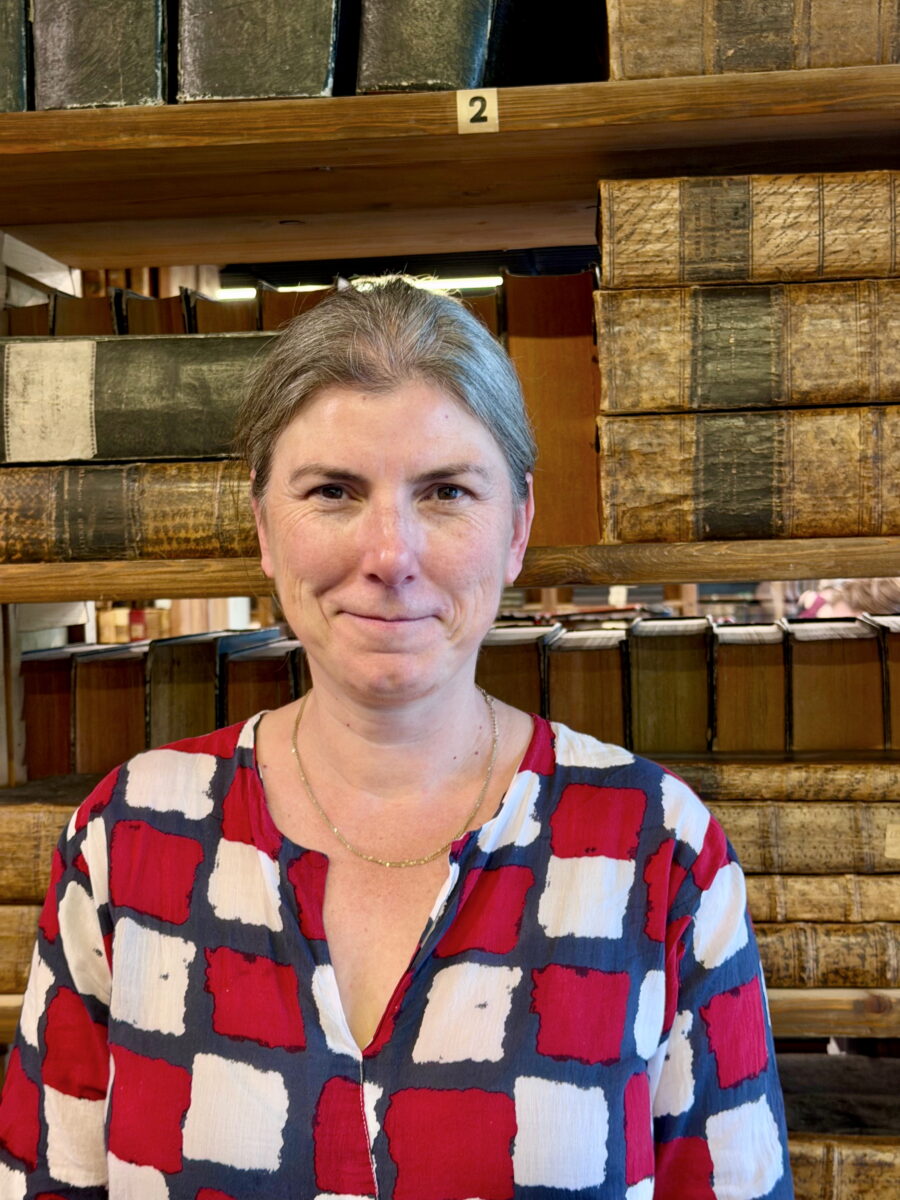
Alison K. Smith
BOARD PRESIDENT CANDIDATE
Alison K. Smith is Professor of History at the University of Toronto. She earned a BA in Russian Civilization and an MA and PhD in History at the University of Chicago. Smith’s research has focused on the social and cultural history of the Russian Empire, including significant projects on the history of food and on the history of social estates and social mobility. Her current research focuses on the town and palace of Gatchina to think about everyday life in an autocratic regime.
Smith’s interests are wide-ranging, as are her publications. She has written two books on the history of food – Recipes for Russia: Food and Nationhood under the Tsars (NIU Press, 2007) and Cabbage and Caviar: A History of Food in Russia (Reaktion Books, 2021) and one on soslovie (social estate) – For the Common Good and Their Own Well-Being: Social Estates in Imperial Russia (Oxford University Press, 2014). Her articles cover an even wider array of topics, from the act of manumitting serfs and its relationship to the concept of freedom (published in The American Historical Review, 2013), to the development of a cotton industry in Ivanovo (published in Past & Present, 2019), to the role of petitions in 18th century administrative culture and political practice (published in Law and History Review, 2025). She has also co-edited two books with Matthew Romaniello and Tricia Starks, most recently A Frozen State: Experiencing Cold in Russian History and Culture (University of Toronto Press, 2026) and is planning a third on animal history.
Smith has received grants from Fulbright-Hays, IREX, and the Social Sciences and Humanities Research Council Canada. She has served as graduate coordinator for the Centre for European and Eurasian Studies and most recently as Chair and Graduate Chair of the Department of History at the University of Toronto. She also teaches across the curriculum, from a large first-year lecture course titled “Ten Events that Changed the World” to specialist seminars on the history of alcohol and on the history of Russia as an empire. Through her teaching she has consistently emphasized the imperial nature of Russia’s past, bringing the many insights of the imperial turn to her students.
A high school class on Russian history sparked Smith’s interest and she started studying Russian language on her first day as an undergraduate. Other than a brief moment when she considered law school, she hasn’t stopped thinking about and studying the region since then. She is of the generation that came into the field just as archival access opened up for foreign scholars. Now as the field settles into a new era of writing around the center, she believes in the central role that ASEEES can play to support scholars as they grapple with what that means, to recognize that states in the region were multiethnic and multiracial in ways that have often been obscured or sidelined, and to support and develop diversity among scholars in the field.