

Winter 2025
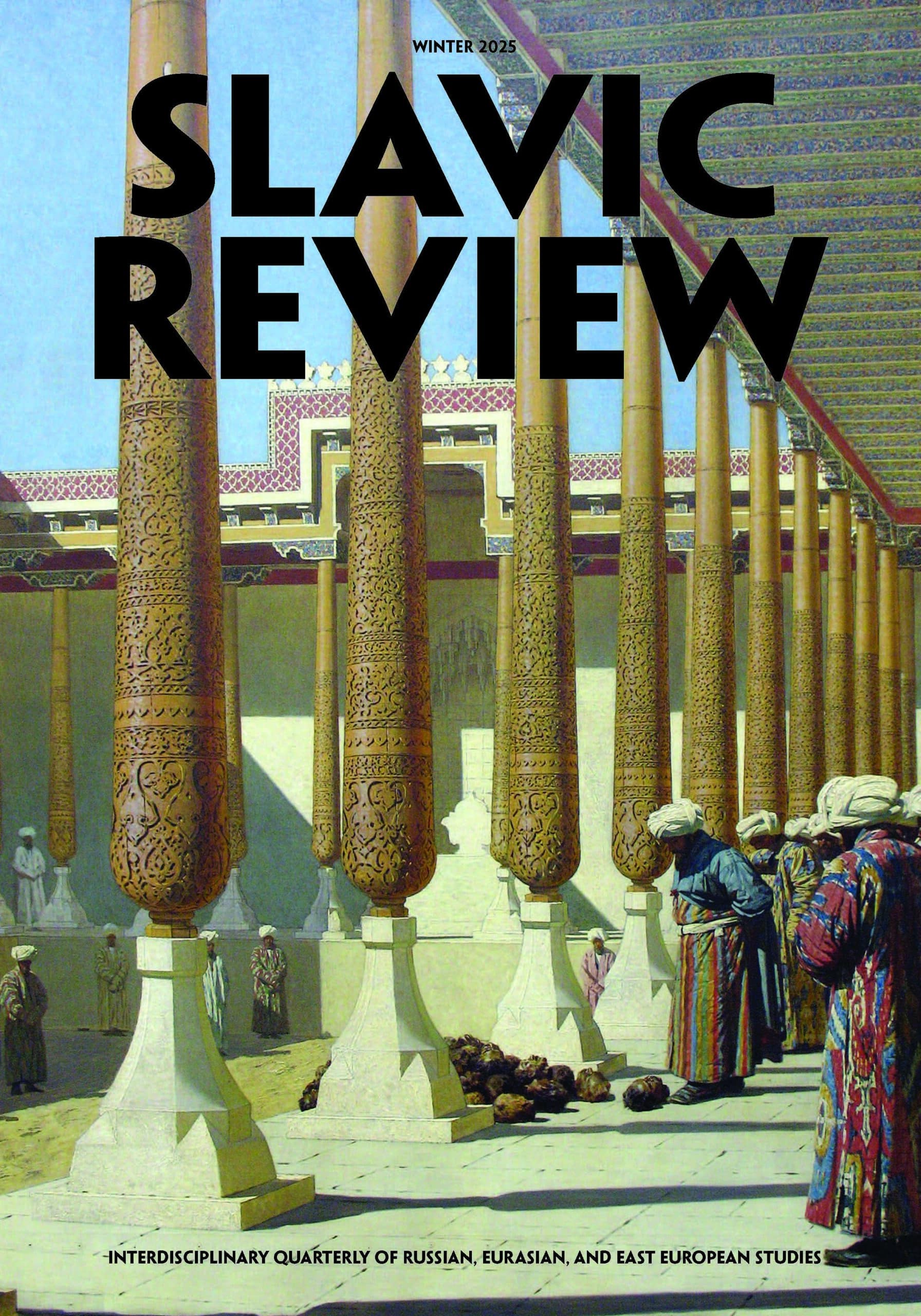
In This Issue
Table of Contents
Cluster: Towards a History of Russian Colonialism
717
Introduction: Step by Step – Towards a History of Russian Colonialism
Paolo Sartori
722
Anglophone Historiography of Russian Empire before the Imperial Turn
Sean Pollock
Abstract
This article challenges historians’ recent Russian-Ukrainian war-related claims that the field of Russian history in the West, and in the United States in particular, has overlooked the imperial and colonial dimensions of Russia’s past. It argues that far from overlooking Russian and Soviet imperialism and colonialism and marginalizing the histories of non-Russian peoples in that context, Anglophone historians have been documenting and explaining them for at least a century. It shows that as early as the 1940s and 1950s, Michael Karpovich and his former Harvard University students emphasized the need to pay greater attention to the history of Russian imperial expansion and colonization, Russia’s borderlands and its non-Russian peoples. By tracing the ways in which Anglophone historians over the next fifty years sought to make sense of Russian and Soviet empire, it becomes possible to see the so-called “imperial turn” in Russian historiography as a return to research agendas that had been established decades earlier and helped make possible the production of historical accounts of Russia arguably free from what Mykhailo Hrushevsky famously dubbed the “traditional scheme of ‘Russian’ history.”
746
Colonialism or kolonizatsiia? Why the Difference between Ukraine and Central Asia Matters
ulrich hofmeister
Abstract
Since the beginning of Russia’s war of aggression against Ukraine in 2014, a view that interprets Russian-Ukrainian relations as colonialism has gained ground in historical scholarship. However, based on an analysis of the terms “colonization” and “colonialism” and a comparison between Ukrainian territories and the Governorate-General of Turkestan in late imperial Russia, this article argues for a more cautious use of the term “colonialism” in relation to Ukraine. It shows that contemporaries rarely viewed Tsarist rule in Ukraine through the prism of colonialism, while in the case of Central Asia this perspective was pervasive. Moreover, Tsarist policy toward Central Asia and its predominantly Muslim population was much more in line with colonial practices than it was in the case of Ukraine. While colonial rule is generally based on the institutionalization of difference, the opposite was the case in Ukraine: Ukraine was appropriated as part of the Russian nation. Therefore, this article argues that Russia’s claims on Ukraine, which deny Ukraine’s right to national self-determination and statehood, are not an indication of colonial subjugation, but rather of nationalist usurpation.
766
Slavic Settlers and Conversions to Islam in Russian Central Asia
paolo sartori
Abstract
In this article I set out to show that tsarist officials and churchmen attempted to discredit anyone who wanted to convert from Orthodoxy to Islam in Russian Central Asia. Surrounded by a Muslim-majority population which they perceived as intrinsically hostile by dint of its religious affiliation, imperial officials regarded any apostate not only as someone breaking the law, but also in moral terms on a par with anyone who passed over to the enemy. I shall devote particular attention to the language employed by colonial authorities to frame apostasy either as the work of Muslim proselytizers or as reflective of a personality disorder on the part of the convert, i.e., poor morals, mental deficiency, or greed. By proceeding in this fashion, I shall argue that Russian colonial officials pursued smear campaign against all successful converts as a means of minimizing and dismissing the phenomenon of Orthodox Christians’ conversions to Islam.
783
The Misadventures of a Dagestani Merchant: Empire and Muslim Mobility in Central Asia
vladimir hamed-troyansky
Abstract
In 1877, Russian authorities in Turkestan arrested an Ottoman mullah who was reportedly spreading anti-tsarist propaganda in the Kazakh steppe. Upon closer inspection, the man turned out to be neither an Ottoman subject nor a Muslim religious leader. This article follows the travels of Hajji Ahmed, a young merchant from Dagestan who was at different times accused of being a Russian spy and an Ottoman spy. His three petitions and tsarist investigative reports reveal that he had traded throughout the Khanate of Khoqand, the Emirate of Bukhara, and tsarist Turkestan in the 1870s. This microhistory of a Muslim peddler offers a glimpse into tsarist anxieties about Muslim mobility and local fears of Russian imperialism in Central Asia. It demonstrates that Russia’s colonial expansion provided new opportunities for tsarist Muslim subjects but also destabilized Central Asian societies and institutions, making the conditions of travel perilous. Tsarist paranoia about Ottoman emissaries, Tatar missionaries, and prospects of an anticolonial uprising led to Russia’s restrictions on transregional Muslim mobility.
Articles
804
Faulty Premises, Poetic Words: Nationalizing Moral Error in Dostoevskii and Heidegger
arpi movsesian
Abstract
This article is a comparative study of Dostoevskii and Heidegger’s messianic nationalism as understood in terms of their conceptualization of primordialism and racial purity. It offers, and further invites, a critical lens especially on Dostoevskii’s prejudices, viewing them as systematic rather than isolated. This article endeavors to offer a comprehensive exploration of the novelist’s essentialist premises through Heidegger’s philosophical framework of similar views on the “other.” Both authors claim that certain “truths” could only spring from the people, whether narod or das Volk. I argue that Dostoevskii and Heidegger arrive at similar warped visions of national destiny due to their formulation of the so-called primordial “call of conscience” and its attachment to their preferred poets. The point of my interdisciplinary effort here is to demonstrate that their racial bias is not limited to incidental remarks but that these biases are deeply embedded in the authors’ broader intellectual projects.
823
More Than a Replica: Exhibiting Nuclear Energy through the Model of the Ignalia Nuclear Power Plant
linara dovyaitytė
Abstract
This article investigates the history of displaying nuclear energy from the 1980s to the present by tracing the cultural biography of a scale model of the Ignalina Nuclear Power Plant, which operated in Lithuania between 1983 and 2009. By reconstructing the model’s trajectory, from its initial role as a promotional exhibit in Soviet-era industry showcase to its contemporary status as an artifact of nuclear cultural heritage, the study highlights shift in the politics and practices of exhibiting the atom, as well as evolving theoretical frameworks and cultural discourses surrounding nuclear energy. The author argues that the model’s movement through industrial, technological, artistic, and heritage domains, along with its diverse functions, has rendered it a techno-political actor that, alongside human and institutional agents, plays a significant role in shaping the dynamics of nuclear culture.
844
Review Essays
844
Russia’s War in Ukraine’s East in Contemporary Ukrainian Literature
Olha Khometa
852
A Failed Geopolitics of Culture, or How Americans Failed to Westernize Russian Libraries, Archives and Russian Culture
Sergei I. Zhuk
Explore More Issues
View All



Submission information
Submissions from all disciplines and perspectives are welcomed. A primary purpose of the journal is to encourage dialogue among different scholarly approaches. Articles are peer-reviewed and editorial policy is guided by an international editorial board.
Subscribe to Slavic Review
Subscribe to Slavic Review by becoming a member of ASEEES. Institutional subscriptions are available through Cambridge University Press.