

Slavic Review is an international interdisciplinary journal devoted to the study of eastern Europe, Russia, the Caucasus, and Central Asia, past and present.
The journal publishes articles of original and significant research and interpretation, reviews of scholarly books and films, and topical review essays and discussion forums. Submissions from all disciplines and perspectives are welcomed. A primary purpose of the journal is to encourage dialogue among different scholarly approaches. Published since 1941, Slavic Review is the membership journal of the Association for Slavic, East European, and Eurasian Studies (ASEEES, formerly AAASS). Articles are peer-reviewed and editorial policy is guided by an international editorial board.
Current Issue
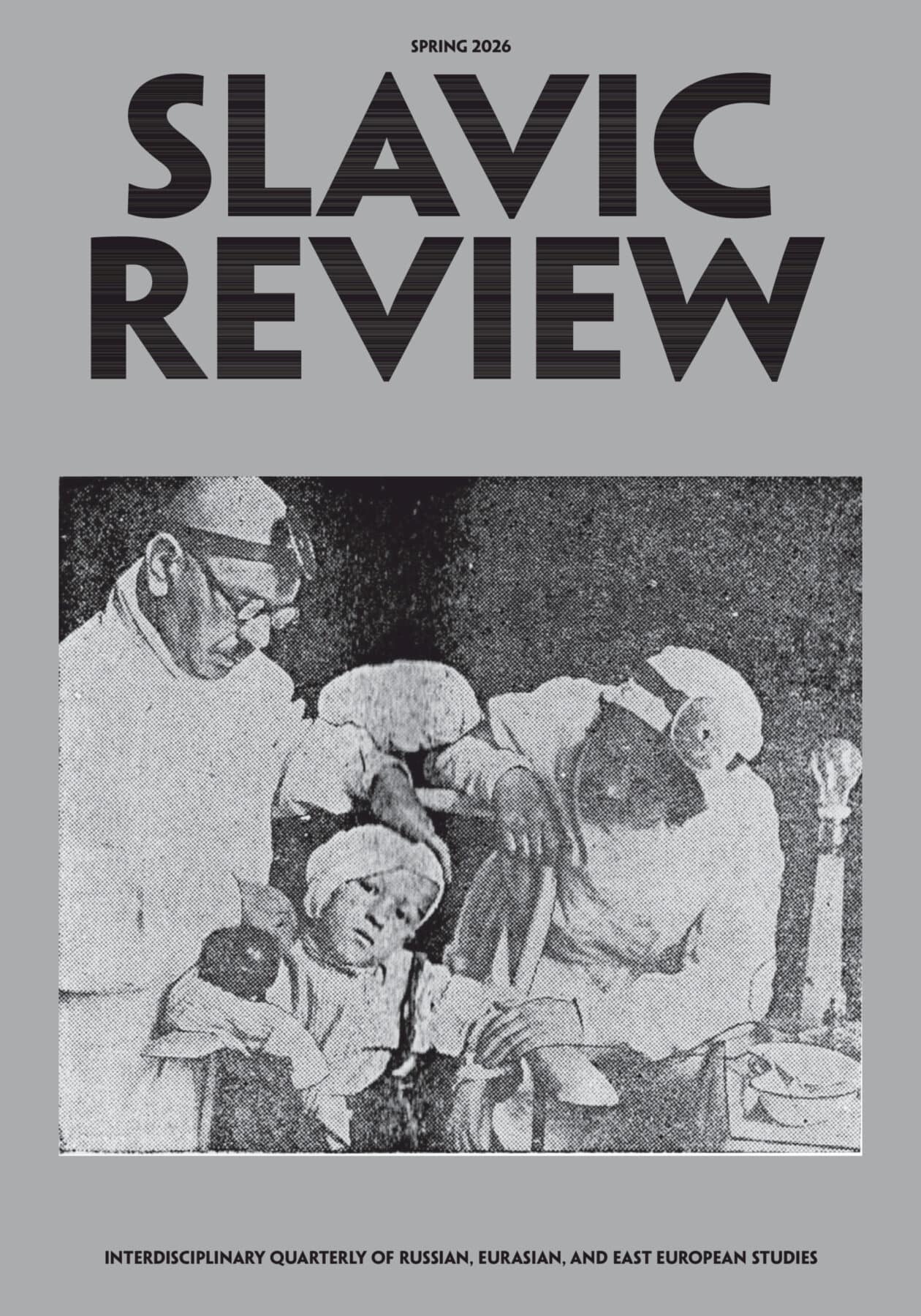
Contents Preview
View AllCLUSTER: DISABILITY IN EASTERN EUROPE AND RUSSIA
Constructing and Deconstructing Disability in Eastern Europe and Russia
Deafness in the Interwar Romanian Press: From “Abnormal” Children to Celebrated Soccer Stars
Contested Normalities: Concepts of Autism in Socialist Bulgaria
The Invalid Fund: Disabled Afghan War Veterans, Violence, and Organized Crime in Post-Soviet Russia
Articles
Returning “Our Royal Animal” to its “Fatherland”: The Near-extinction and Restoration of Bison in Poland after World War I
The Lviv Pogrom as an Epistemic Event: Violence, Denial, and Knowledge in Postimperial Poland
The Barber-Surgeon and the Schismatic: Reframing an Icon of Russian Modernity
The Rise of Ruscism/Russism: Pro-War Contemporary Art in Russia and Its Genealogy
BOOK Forum: crucibles of power

Submission information
Submissions from all disciplines and perspectives are welcomed. A primary purpose of the journal is to encourage dialogue among different scholarly approaches. Articles are peer-reviewed and editorial policy is guided by an international editorial board.
Subscribe to Slavic Review
Subscribe to Slavic Review by becoming a member of ASEEES. Institutional subscriptions are available through Cambridge University Press.
Recent Issues
View All



Slavic Review Announcements
-
Slavic Review 85.1 Spring 2026 issue now available
Members can access the Spring 2026 Issue of Slavic Review through Cambridge Core here
-
New Featured Discussion available
A new Featured Discussion, “Towards a History of Russian Colonialism,” is now available on the Slavic Review website in the Discussions section. The discussion features short pieces by Ulrich Hofmeister, […]
-
First View Articles available for Spring 2026 issue
FirstView articles for the Spring 2026 issue are now available via Cambridge Core: “The Barber-Surgeon and the Schismatic: Reframing an Icon of Russian Modernity” by Ernest A. Zitser and “The […]