

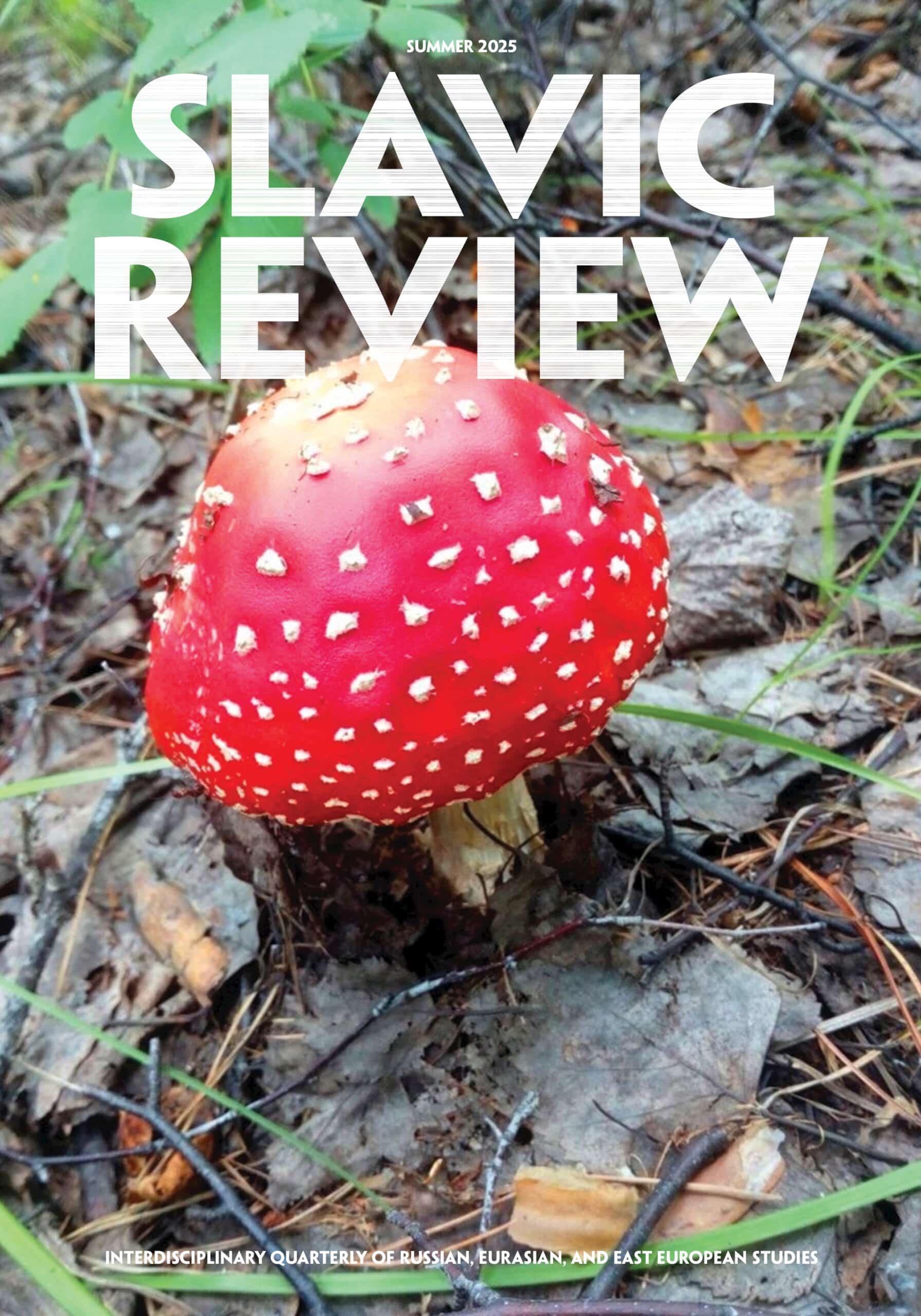
Summer 2025
In This Issue
Table of Contents
CRITICAL FORUM: ENTANGLED SPATIAL HISTORY
247
Horizontal Threads: Towards an Entangled Spatial History of the Romanov Empire
Catherine Gibson and anton kotenko
Abstract
This article outlines an emerging new approach in the spatial history of the Romanov Empire. Traditionally, similarly to other empires of the long nineteenth-century, the Romanov Empire has been understood as a spoked wheel, whose vertical axes of power and lines of communication flowed between the metropolitan “core” and the “peripheries.” We argue for a need to move beyond this well-worn image of the empire as a vertical structure of “centre-periphery” relations. Instead, we consider the heuristic potential of studying horizontal “periphery-periphery” entanglements interconnecting this state; threads, which were not necessarily woven through the metropole. The argument is illustrated through a discussion of several examples from the Baltic and Southwestern provinces, which highlight both the challenges and potentials of the approach.
VIEWPOINTS
266
Knock-Knock-Knockin’ on an Open Door?
paul w. werth
Abstract
This “viewpoint” essay offers a response to the article by Catherine Gibson and Anton Kotenko, “Horizontal Threads” After recounting the article’s main propositions, the essay assesses its argument and the potential that its program represents for the study of the Russian Empire’s spatial history.
270
Spatial Scenarios in the History of the Romanov Empire
susan smith-peter
Abstract
The wide-ranging spaces of Russia in its various guises have not always been reflected in historical narratives, which for many years focused on Moscow and St. Petersburg. This viewpoint piece focuses on how the entangled histories approach could be applied to tell the empire’s story without telling an imperial story. It ends with asking which vertical threads from the center are necessary to weave together a coherent narrative.
274
Threads, Entanglements, and the Work of Empire
tony ballantyne
Abstract
This response to “Horizontal Threads: Towards an Entangled Spatial History of the Romanov Empire,” reflects on shifting approaches to the structure of empires and the power of entanglement as an analytical tool for making sense of the incorporationist work of empire.
Articles
278
The Engineers of Children’s Fingers: Children’s Music, Soviet Internationalism, and the Problem of Ukraine’s National Instrument
Maria Sonevytsky
Abstract
How can an icon of romantic Ukrainian nationalism be refashioned into a tool for building Soviet internationalism? This article tells the story of the bandura—the musical instrument constructed in the 19th century as an icon of romantic Ukrainian nationalism—and its fraught integration into the culture of Young Pioneers in early Soviet Ukraine. Focused on the shift in cultural policy from Leninist korenizastiia to Stalinist socialist realism, this article examines how the emancipatory and universalizing claims of Soviet internationalism became premised on Russified culture which inhibited the possibility of non-Russians’ full assimilation into the project of Soviet revolution. In the hands of Young Pioneers, who were appointed as Soviet “revolutionary agents” and as targets of the state’s pastoral care (“Stalin’s flowers”), the bandura became a particularly vexed symbol, epitomizing the irreconcilable tensions and the apparently inevitable violence inherent to nationalities policies in Soviet Ukraine. Following the intergenerational saga of a family of bandurists, the article shows how the disciplining technologies of Soviet musical-political education yielded often unexpected results.
302
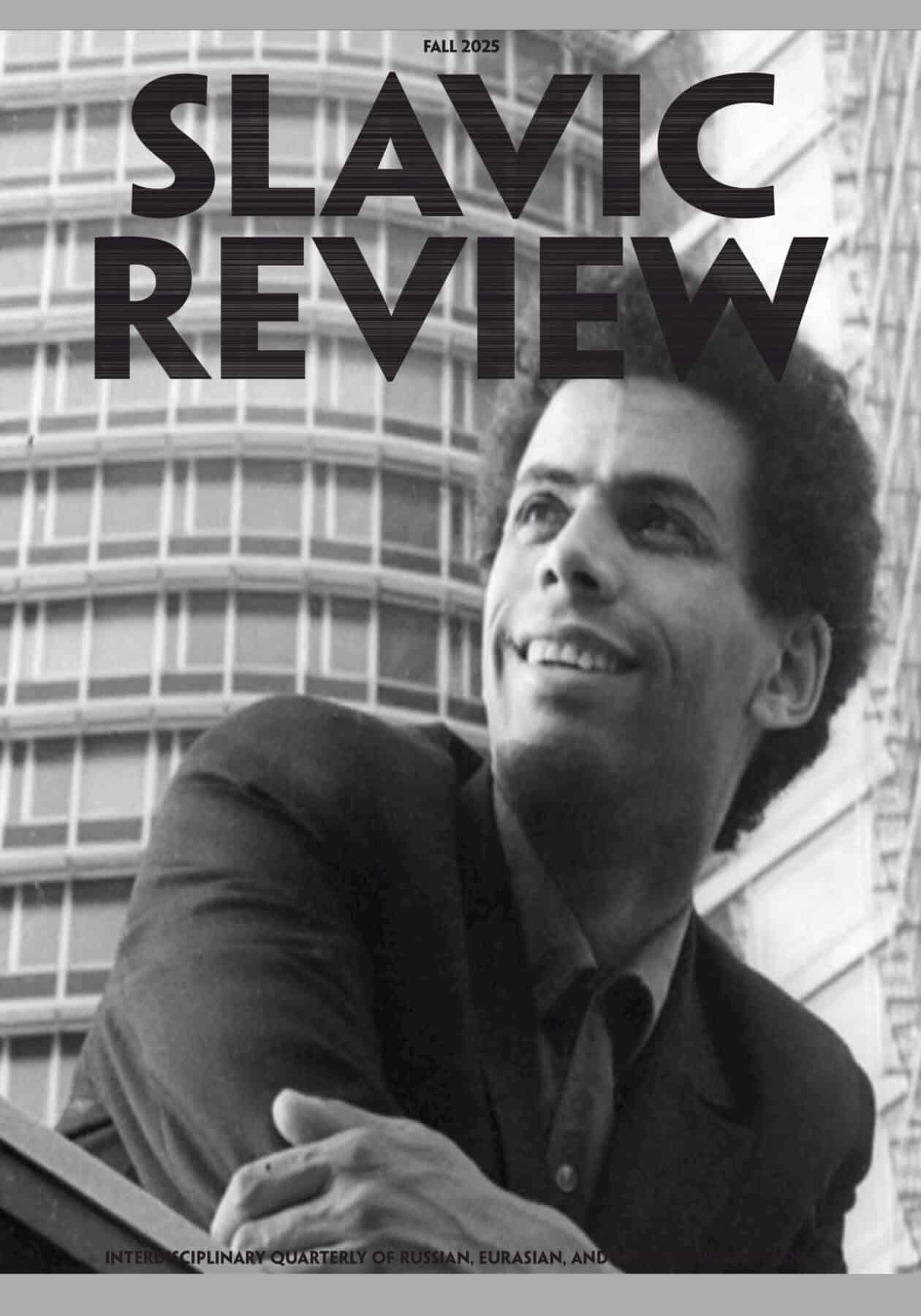
Yugoslav Film in Black and White
Sunnie Rucker-chang
Abstract
The films Valley of Peace (1956), Jagoš i Uglješa (1976), Tit for Tat (1978), and A Great Guy at Heart (1981) represent exceptions among the Yugoslav film canon because they include Black actors among their casts. Given that the majority of Yugoslavs were racialized as “white,” the Black actors in these films emerge as a type of filmic device, providing social commentary on the post-WWII geopolitical priorities of Yugoslavia, including antiracism, international nonalignment, and Third World solidarity. Film was easy to distribute and consume and it became integral to the creation and maintenance of post-WWII Yugoslav culture. Through its content, storylines, and plot, an image of the idealized national Yugoslav body emerged which included Black men. In this article, I analyze the aforementioned films against the backdrop of the goals and traditional frames of Yugoslav cinema to highlight and offer insight into the uses and symbolism of blackness on screen.
318
Pieśń o ziemi: Bronisława Niżyńska and the “Stylization” of Polish National Culture
jordan lian
Abstract
This article examines Bronisława Niżyńska’s (Bronislava Nijinska) ballet, Pieśń o ziemi (1937), in the Polski Balet Reprezentacyjny’s inaugural 1937–1938 season. The Polski Balet Reprezentacyjny was an ensemble instituted by the Ministry of Foreign Affairs to represent the Second Polish Republic as cultural diplomats. Domestic reviews betray conflicting opinions regarding Niżyńska’s role as an artistic representative of the Second Polish Republic. Therefore, this article argues that tepid reception of her choreographic work reveals an underlying hesitancy towards accepting her as a national artist. At the centre of these questions remains the puzzling consideration of Niżyńska, who was situated between Europe’s modernist ballet tradition, heavily shaped by Russian émigrés, and Polish national culture. Examining Niżyńska’s choreographic praxis and complex biography suggests the reconsideration of Niżyńska as a purely Russophone artist, bringing to the fore the hitherto underexplored Polish dimension of her identity.
337
“Take it as a Fairy Tale”: Varlam Shalamov as a Storyteller
Emily Van Buskirk
Abstract
The question of the genre of The Kolyma Stories continues to perplex readers: the tales resemble fiction and are at the same time intended to serve as document, evidentiary proof of the evils of Stalinism. In this article I reconsider Walter Benjamin’s “Storyteller” essay, arguing that Shalamov is, in significant ways, a Benjaminian storyteller, updated to catastrophically unfree conditions and minus any nostalgic lens. Taking Shalamov’s prose not just as document and fiction, but more specifically, as document and story allows for a deeper understanding of his creative process, aesthetics, and how his prose is intended to act on the reader. Shalamov becomes a storyteller in part to break free from what he saw as the didactic tradition of the Russian novel. I compare Benjamin’s notions of storytelling to Shalamov’s concepts of “new prose,” and then scrutinize Shalamov’s contradictory stance on whether his stories contain “lessons” (advice is central to Benjamin’s framework). I touch on the fusion of document and folktale in several stories, referring to Vladimir Propp’s Morphology of the Folktale. Finally, I examine “Galina Pavlovna Zybalova” (1970-71), which, I argue, demonstrates how skazka and story function in relation to memory and advice.
357
A Generation on Mushrooms: Mukhomor and Visions of Russianness in Victor Pelevin’s Generation P
Katerina Pavlidi, Oliver Ledwith, and Nathan edward charles Smith
Abstract
Victor Pelevin’s novel Generation P has attracted both popular and academic interest for its ability to capture the zeitgeist of Russia in the 1990s and a generation searching for a new identity in the ruins of the Soviet Union. However, one element has been largely ignored by scholars: the role of fungi and, specifically, the entheogenic mukhomor. Here we discuss the history of mukhomor in the Russian context and demonstrate how Pelevin’s representations of mukhomor advance the novel’s critique regarding the reinvention of Russia’s identity after the fall of the Soviet Union. We argue that via its mukhomor-induced hallucinations, the novel ironizes the imperial narratives which sought to restore an idealised but allegedly authentically Russian past. The novel plays with the idea that if there is a future that can qualify as authentically Russian, then it should be one where the very notion of Russianness is abandoned. What renders this future authentically Russian is the genetic origin of mukhomor in the Russian hinterland – the very element which enables a vision of the world as such, devoid of symbolic order and of all identities.
Review Essays
377
Molding the Mass Viewer: New Insights into the Early Soviet Art System
wendy salmond
381
When Did National Identities Take Over Hapsburg Cities?
andrew demshuk
388
In Search of Lost Timelessness: Refraiming the Russian Cannon
Chloë Kitzinger
395
The Potential and Limitations of Sport: Insights from Recent Scholarship
Jennifer Parks
Explore More Issues
View All



Submission information
Submissions from all disciplines and perspectives are welcomed. A primary purpose of the journal is to encourage dialogue among different scholarly approaches. Articles are peer-reviewed and editorial policy is guided by an international editorial board.
Subscribe to Slavic Review
Subscribe to Slavic Review by becoming a member of ASEEES. Institutional subscriptions are available through Cambridge University Press.