

Spring 2026
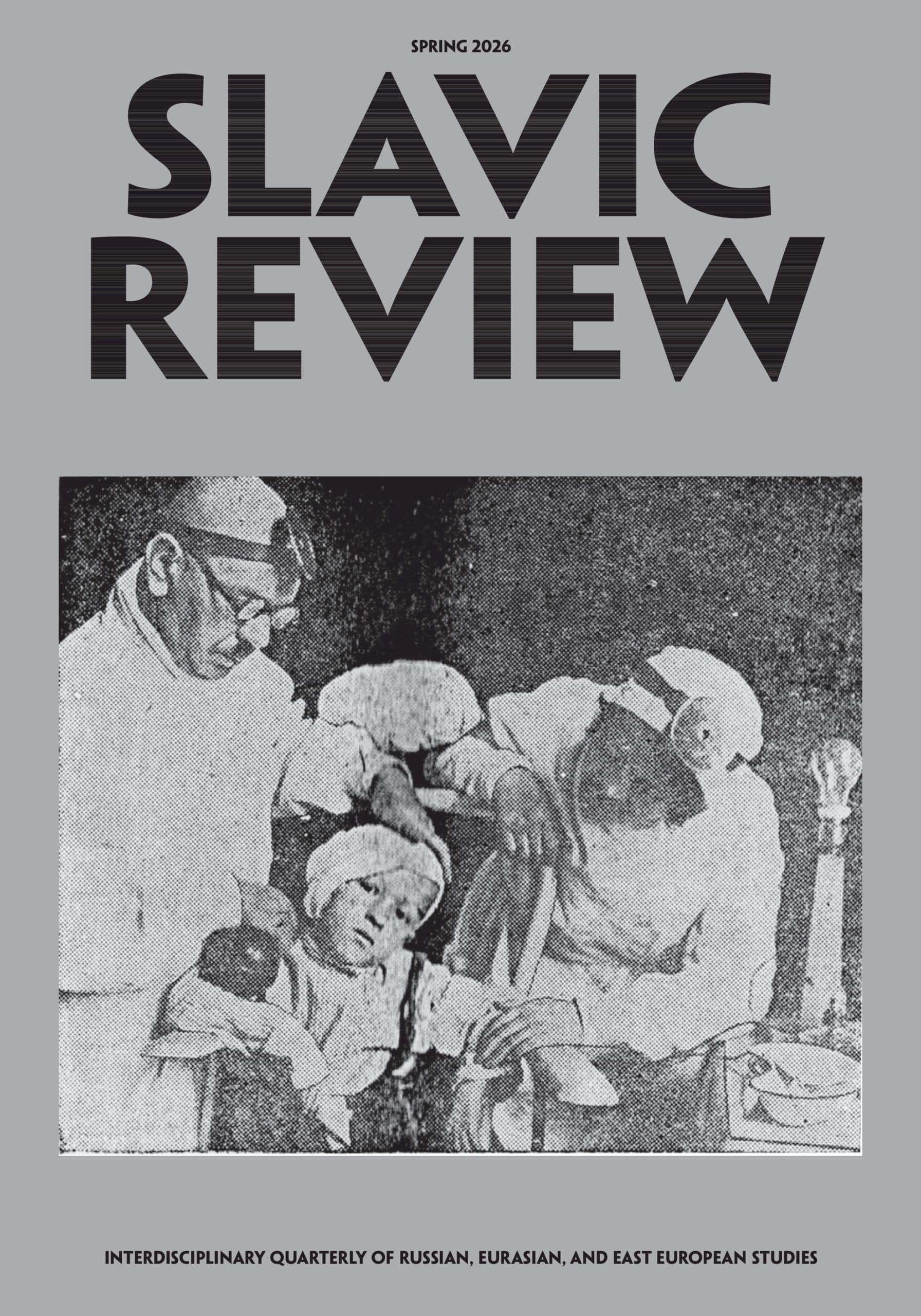
In This Issue
Table of Contents
Cluster: Disability in Eastern Europe and Russia
1
Constructing and Deconstructing Disability in Eastern Europe and Russia
Maria Cristina Galmarini and Maria Bucur
Abstract
The introduction to the cluster on disability history in Eastern Europe and Russia provides a framework for situating the three case studies within the larger development of the field. The introduction highlights important themes and arguments presented by the three authors.
4
Deafness in the Interwar Romanian Press: From “Abnormal” Children to Celebrated Soccer Stars
Maria Bucur
Abstract
This article focuses on the use of the terms “deaf” and “deaf-mute” in the interwar Romanian press to explore the multiplicity of meanings attached to this condition in different types of public discourse. My aim is to place in the larger context of that period what meanings become most prominent in newspapers and other forms of popular press, why, and with what consequences. I offer an exploration of these discourses, to better appreciate how the reading public, both able-bodied and disabled, saw disability represented. Rendering the very multiplicity of meanings attached to “deafness” visible in the relevant context is an important goal for this essay; it allows us to better understand the continued imprecision and stigmatizing framework in how Romanian society engaged with the deaf. I also explore what space existed for the deaf community to shape their own self-representations. Placing ableist discourses in dialogue with the voices of the deaf community is an important aim, as a method to de-essentialize the predominant ableist discourses and normalize accounting for disability as a significant element of modern history.
24
Contested Normalities: Concepts of Autism in Socialist Bulgaria
Gergana Mircheva
Abstract
The manuscript offers a historical reconstruction of the psychiatric concepts of autism in Bulgaria during the period of state socialism. The object of research includes the normative models for dealing with this disability. Such normative models are analyzed as part of the conventions of “(ab)normality”, determined by particular psycho-medical and more general socio-cultural scripts. The aim is to trace the historical dynamics of these models and to answer the questions: to what extent, why and how did psychiatrists adopt, modify, combine and/or confront such models? How did the vision of extreme isolation and social aloneness, ascribed to autism, fit into the conceptual and ideological frameworks of Bulgarian socialist psychiatry? What was the disability politics of Bulgarian socialist psychiatry towards children with so called “early infantile autism”? The empirical data of analysis includes textbooks, monographies and articles in child psychiatry, semi-structured interviews with experts and archive materials. Their interpretation combines social history and disability studies through discourse analysis.
44
The Invalid Fund: Disabled Afghan War Veterans, Violence, and Organized Crime in Post-Soviet Russia
Emily Hoge
Abstract
This article examines the Russian Fund for Invalids of the War in Afghanistan (RFIVA), a post-Soviet disability organization whose disabled veteran members became involved in organized crime after the collapse of the Soviet Union, ultimately culminating in the 1996 Kotlyakovskoe Cemetery bombing. When the Soviet state vanished, disabled people felt the effects of its absence most harshly. But disabled veterans of the Soviet-Afghan War, who had constructed a shared identity around violent disabled masculinity, found both solidarity and profit in the sale of violence in the hyper-capitalist, neoliberal Russia. During Russia’s transition to a market economy, a small part of the Afghan veteran’s movement formed into criminal and semi-criminal organizations, including the Russian Fund for Invalids of the Afghan War (RFIVA). The organization eventually splintered over disagreements regarding its obligations to provide care for disabled veterans—a reflection of broader questions over the relationship of disabled people to Russian society.
Articles
61
Returning “Our Royal Animal” to its “Fatherland”: The Near-extinction and Restoration of Bison in Poland after World War I
Nathaniel D. Wood
Abstract
In the aftermath of WWI, soldiers and poachers killed the last European bison in Białowieża Forest, the former hunting grounds of kings and tsars. Over the next two decades, Polish zoologists and hunter-naturalists—as representatives of a “restored” Polish state—worked with international organizations to revive the species from the few animals scattered on estates and zoos across Europe and restore “purebred” bison to Białowieża. Exploring archival documents, hunting magazines, specialist publications, and the popular press, this article argues that Polish naturalists and officials valued the wildness of Białowieża and wished to see the “royal animal” return to its “fatherland” but doubted the civilized status of the region’s inhabitants, who had hunted the bison to extinction. Much as the state sought to Polonize and civilize the human inhabitants of the forest, these naturalists sought to manage bison for the benefit of two superseding collectives, the nation and the species.
80
The Lviv Pogrom as an Epistemic Event: Violence, Denial, and Knowledge in Postimperial Poland
Jagoda Wierzejska
Abstract
This article analyzes the Lviv pogrom of November 1918 as an epistemic event embedded in the postimperial transformation of East Central Europe. It argues that the violence, and its subsequent narration, became a critical site for negotiating the boundaries of political legitimacy, historical memory, and minority recognition. Tracing competing Polish and Jewish knowledge practices—ranging from official denials and mythologized narratives of urban defense to acts of documentation, legal contestation, and international advocacy—the article conceptualizes pogroms as structured scenes of epistemic asymmetry. These dynamics reveal how emerging nation-states instrumentalized epistemic violence not only to contain minority testimony but also to stabilize symbolic authority. The case of Lviv illustrates how discursive control, no less than coercion, underwrote the consolidation of national narratives in the wake of imperial collapse. In advancing this framework, the article contributes to broader debates on political violence, memory, and the epistemology of state formation.
100
The Barber-Surgeon and the Schismatic: Reframing an Icon of Russian Modernity
Ernest A. Zitser
Abstract
This article presents a new reading of one of the most famous images of Russian visual culture: the eighteenth-century popular print (lubok) known as “The Barber Wants to Cut the Beard of the Old Believer.” After reviewing the existing historiography and offering evidence for an alternative dating, I argue that this xylograph is less a folksy illustration of Peter I’s “cultural revolution” than a manifestation of the tastes of mid-eighteenth-century Russian Orthodox city-dwellers, a social group that as the primary audience for this cheap, mass-produced, consumer product would have found it amusing and entertaining. From this perspective, the printmaker’s use of a religious slur was not metaphorical or incidental to the design of the lubok. The othering of cultural outsiders was as integral to the meaning of this composition as the literary tropes of commedia dell’arte and the visual conventions for representing popular wrestlers.
125
The Rise of Ruscism/Russism: Pro-War Contemporary Art in Russia and Its Genealogy
Nikolay Smirnov
Abstract
This essay examines project Russian Style (2022–25) as a “flagship” example of pro-war contemporary art in Russia. It investigates the cultural logic of Putin’s Russia, conceptualized as Ruscism/Russism—an articulation of Russian-identitarian, nationalist, and imperialist segments of society. Linked to populist resentment and the ongoing struggle for hegemony, Ruscism/Russism operates as a mindset, a geographic imagination, spatial identity, and technology. To illuminate its syncretism and its formation within—and reshaping of—the art field, this essay examines three principal sources—late‑Soviet official art, nonconformist art, and Neo‑Eurasianism as a transgressive subculture—through case studies of Oskar Rabin, Nikolai Andronov, and Alexei Belyaev‑Gintovt, leading figures in these strands. Ruscism/Russism has coalesced from the geoculturally specific, nationalist, and imperialist elements present in these sources, appropriating and intensifying them in novel ways. Methodologically, this study draws on art history, cultural criticism, and cultural geography to investigate contemporary Russia through its art and culture.
BOOK FORUM: CRUCIBLES OF POWER
146
The Anatomy of Soviet and Nazi Power: Crucibles of Power Forum
Jan burzlaff
Abstract
This lead article introduces the Crucibles of Power forum, highlighting Michael David-Fox’s groundbreaking study of Smolensk under Stalinist and Nazi rule. Crucibles of Power offers a model social history of occupation, weaving together Soviet and German sources, survivor testimonies, and decades of scholarship to dismantle binary frameworks of totalitarian theory. By reframing power as a fractured and negotiated process, David-Fox reveals how overlapping regimes shaped individual choices, collaboration, and violence. Key themes-such as ‘biographical logics,’ the entanglement of Nazi and Soviet systems, and the performative dimensions of fear, rumor, and denunciation-anchor this forum’s discussions by Jochen Hellbeck, Elena Osokina, and Anna Krylova, alongside David-Fox’s own response. Read against the present, this book warns how authoritarian regimes are assembled, naturalized, and remembered. The article argues that Crucibles of Power not only reshapes our understanding of Stalinism and Nazism but also calls for new comparative histories of violence, emotion, and survival across Eastern Europe.
151
The Smolensk Story
elena osokina
Abstract
This article contributes to a journal discussion of Michael David-Fox’s new book, Crucible of Power. The book brings together the major phenomena of the 20th century: Stalinism, Nazism, WWII and the Holocaust. Emphasizing the richness of material and thought, the article focuses on such key points of the book as the dilemma of choice in people’s decisions to either resist or collaborate, the role of Nazi ideology in the self-destruction of the Nazi regime and the synergy of waves of colossal Nazi crimes. In its critical comments, the article notes a marginalization of economic issues. To further conceptualize the socio-economic narrative presented in the book, the article proposes a reinterpretation of the nature of the Stalinist/Soviet economy as a symbiosis of state regulations and the market, thereby challenging the rigid bipolar vision entrenched in Cold War terminology and narratives.
156
Smolensk Under Nazi and Soviet Rule
jochen hellbeck
161
Power, Agency, and Modernity in Michael David-Fox’s Crucibles of Power
anna krylova
Abstract
With his book Crucibles of Power: Smolensk Under Stalinist and Nazi Rule, Michael David-Fox joins one of the most consequential academic conversations that over the past forty years has redefined the way historians and social scientists approach the study of society. It is the conversation on the nature of power and human agency under imposing conditions of modernity. David-Fox’s particular intervention into the problem might strike a well-informed reader as somewhat counterintuitive. Tracing the political history of Stalinism from the 1920s into the 1940s, he proposes to rethink the workings of modern power in its revolutionary-Stalinist incarnation not from the grounds of its center but from a “place far from Moscow”: the Smolensk region and its local institutions and actors. Into the foreground thus come regional party bosses, rank-and-file activists, peasants, collective farmers who confront the grand historical events that invade and shatter their lives—the Smolensk Affair, the collectivization, the Great Terror, the Great Patriotic War, the German occupation—with savvy resistance, manipulation, and perseverance. Be it entrenched regional elites with a mind of their own or village youth such as Vasilii Maslennikov, determined to escape the collectivized and malnourished countryside, the collective portrait of David-Fox’s historical protagonist captures the infinite dynamics of choice, life, and death in the middle of the long Stalinist Revolution. It brings into full view how ordinary people living in extraordinary times confront challenges, make choices, ultimately exercise agency, and, in David-Fox’s words, “could potentially become both victims and perpetrators, powerless in one area and powerful in another.”
164
Power, Ego-Documents, and Agency: Stalinism and Nazism in the Twenty-First Century
michael david-fox
Abstract
In this response to the four contributions to the Critical Forum on Crucibles of Power: Smolensk Under Stalinist and Nazi Rule, Michael David-Fox reflects on how our own twenty-first century crisis of liberalism may provoke new engagements with the twentieth-century age of extremes. His dialogue with commentators and critics is grouped into four areas. The first concerns how to reconceive the old comparison between Stalinism and Nazism in terms of entanglements and the non-synchronous life cycles of revolutionary regimes of far Left and far Right. The second is an explanation and defense of power and power relations as the work’s overarching focus, acknowledging decisions that entailed in terms of the research agenda. The third represents an intervention into a controversy over evidence, the Mints Commission interviews on the Great Patriotic War, and the utility of memoirs. The last section unpacks and refines the author’s approach to the concepts of choice, decision-making, and agency.
Explore More Issues
View All



Submission information
Submissions from all disciplines and perspectives are welcomed. A primary purpose of the journal is to encourage dialogue among different scholarly approaches. Articles are peer-reviewed and editorial policy is guided by an international editorial board.
Subscribe to Slavic Review
Subscribe to Slavic Review by becoming a member of ASEEES. Institutional subscriptions are available through Cambridge University Press.