

Spring 2025
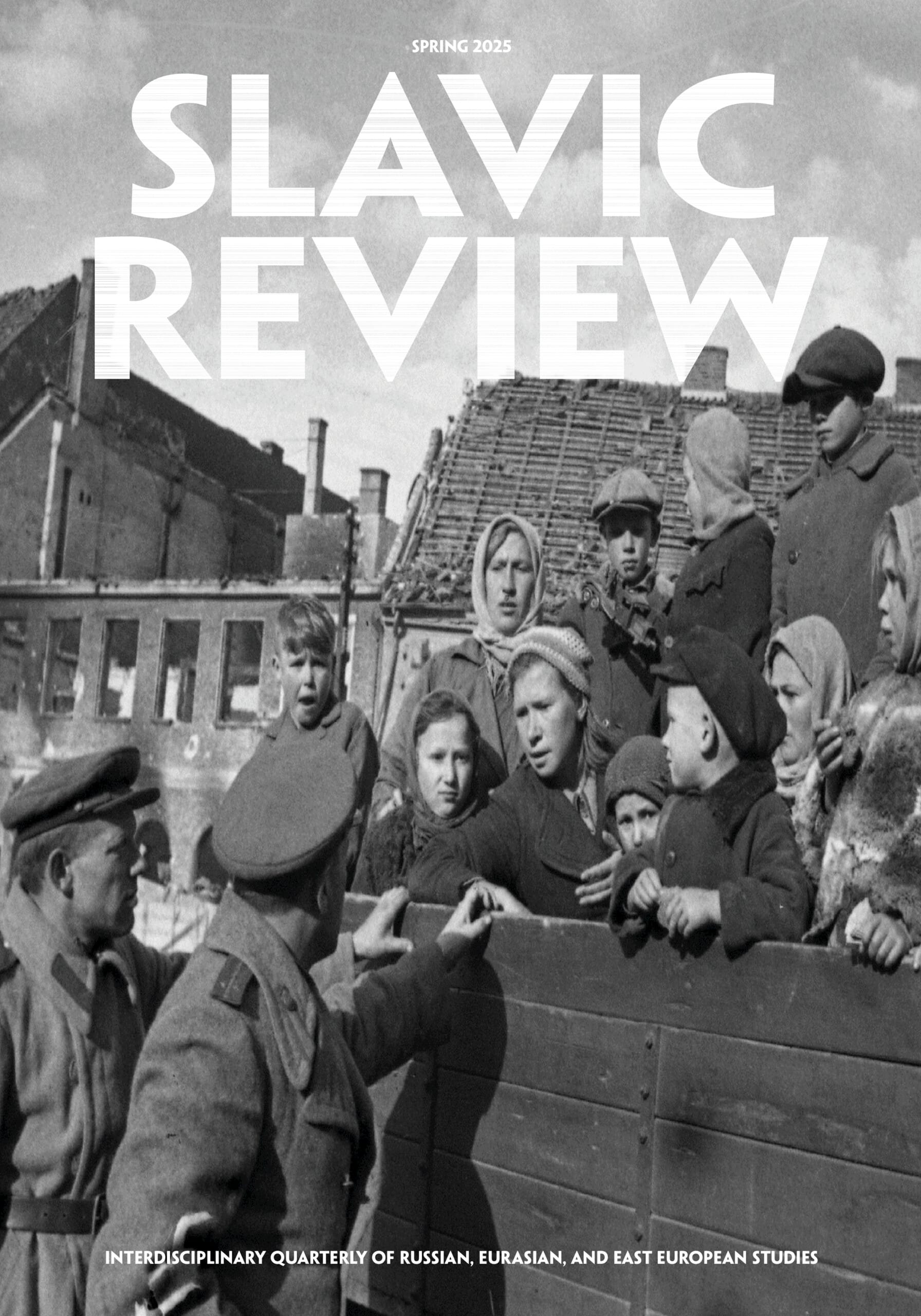
In This Issue
Table of Contents
DIGITAL HUMANITIES
1
AI as a Historical Lens: An Experiment in Periodization of Russia’s State Photography Archive with Neural Networks
seth bernstein
Abstract
Chronology is an important framing mechanism in history and changes significantly based on who defines historical eras. The area studies field has recently grappled with the need to decenter perspectives and reconsider the sources that scholars use. This article uses deep learning artificial intelligence methods to process 169,634 images from the Russian State Documentary Film and Photo Archive (RGAKFD), a major archive of photography in the region, as containing a statist chronological logic, one defined by political change in the center. By peering under the hood of the algorithm’s predictions, by thinking with the machine, it is possible to see patterns in the images that may not seem crucial to the human eye. Looking at RGAKFD as a potential source of data for AI raises parallels between algorithmic bias and the Moscow-centric bias of sources, while also providing opportunities to use such methods as a tool for exploratory research.
23
The Failure of Form: Reading Liminality Computationally in Dostoevskii’s The Double
katherine bowers and kate holland
Abstract
This article uses computational text analysis to examine Fedor Dostoevskii’s The Double, responding to the long-standing critical debates surrounding the text and particularly its form, which Dostoevskii saw as having failed his idea. It asserts that the problem of the ontological status of Goliadkin’s double can be productively considered through an analysis of the text’s use of liminality, a hallmark of romantic fantastic literature. TEI-XML encoding of liminality identified in the text enables a series of visualizations that show that liminality is primarily concentrated in interior spaces. Analyzing the visualizations, the authors argue that liminality is associated with Goliadkin’s social shame, suggesting that the double is an extension of Goliadkin’s psychology rather than a fantastic apparition. Using The Double as a case study, the authors argue that computational text analysis can extend and enrich traditional philological methods by enabling deep structural analysis of the text.
ARTICLES
43
Captivating Cartoons: Normalizing Hatred
martha lampland
Abstract
In 1940s Hungary, there were two political parties—National Socialists on the right and communists on the left—typically depicted in mainstream media as extremist and prone to violence. They shared one crucial feature: both published joke magazines. Clearly envisioned as tools to recruit followers, their periodicals also served a broader purpose in transforming extremist ideas into commonsensical propositions for debate. Their rhetorical strategies were remarkably similar, consisting of three stages: 1) depicting disturbing conditions intended to inflame sentiments, 2) presenting a different view to convey the party’s preferred political stance, and finally 3) sketching ambitions for the future. Readers were led along a carefully orchestrated path into an alternative view of political possibilities, more effective for being dispersed along familiar avenues in Hungarian humor. The analysis is informed by the work of Jean-Paul Sartre, Sara Ahmed, and Thomas Szanto on the pleasures of hating and the allure of a community who hate together.
64
Between Rocks and a Hard Place: Village Heads in Polish Villages during the German Occupation and the Holocaust
Lukasz Krzyzanowski
Abstract
The vast majority of Polish citizens lived through World War II and the Holocaust in the countryside. Nevertheless, power relations in rural communities have been largely overlooked by contemporary historiography. This study examines a profoundly liminal position of Polish village heads (sołtysi) in village communities during WWII. These lowest level clerks present in every Polish village faced intractable dilemmas and were often torn between the Nazi regime and their own communities. The case of village heads serves as a prime example of how the German occupier outsourced daily management of the occupation, exploited pre-existing structures and traditions, and used indirect rule in the communities it controlled. The paper discusses the role of village heads in creating the reality of occupation in the Polish countryside and the extent to which these village officials facilitated and participated in the Holocaust. The study is based primarily on early postwar trial documentation, Holocaust survivors’ testimonies, and village community records, most of which originate from the former Radom District of the General Government (today central Poland).
79
The Unbearable Lightness of Liberalism: The Soviet State and the Idea of Global Trade
Alessandro Iandolo
Abstract
This article examines the Soviet state’s contribution to the liberalization of international trade from the mid-1960s to the late 1970s. Looking at the USSR’s participation in the United Nations Conference on Trade and Development (UNCTAD), the UN agency dedicated to trade liberalization, the article reveals the Soviet state as an actor that pursued multiple and often contradictory goals at once. The purpose of the article is to complicate the view of the Soviet state as a “liberal subject,” an actor that always sought its self-interest. It calls for historians of the Soviet state to engage with the political, ideational, and emotional dimensions of economic exchanges to investigate the USSR’s place in the global economy.
96
“This Is Not Art but the Most Real Life”: Ideology, Literature, and Self-creation in a Soviet Teenager’s Diary (1937–1941)
Ekaterina Zadirko
Abstract
This article closely examines the diary of Ivan Khripunov (1923–1942?), a peasant teenager from the south of Russia. I argue that in his diary, Ivan did not narrate his self with the use of Soviet language but rather aspired to develop as a narrator, learning how to write according to Soviet guidelines to then pursue a writing career. I rely on Iurii Lotman’s theory of communication, which allows me to regard the diary simultaneously as a “message” (representation of the diarist’s experiences) and a “code” (the diarist’s self-instructions on how to make sense of those experiences). The article is divided into three parts: in the first section, I discuss Ivan’s claim that his diary was a chronicle and explore how Socialist realist categories shaped his writing. In the second section, I analyze his autobiography written as one long diary entry and modelled after Maksim Gorʹkii’s autobiographical novel My Childhood (1914). I show that Ivan intended to assemble his future writer’s reputation on Gorʹkii’s example. Lastly, I look into a fictional story The Death of Vasilii Rebrov, also incorporated into the diary to solidify the creation of Ivan’s narrator-self.
115
“Well-Known and Sincerely Loved”: Banal Nationalism, Republican Pride, and Symbolic Ethnicity in Late Soviet Ukraine
Fabian Baumann
Abstract
This article argues that the late Soviet period saw a new form of Ukrainian nationhood emerge, one based less on ethno-historical commonalities than on territorial and institutional cohesion. Combining Michael Billig’s notion of “banal nationalism” with Alexei Yurchak’s analysis of “hypernormalized authoritative discourse,” it shows that Soviet Ukrainian leaders reproduced the assumption of Ukrainian nationhood even as they deprived it of concrete political and cultural content. While First Secretary Petro Shelest still promoted ethno-historical topoi alongside pride in Ukraine’s republican quasi-statehood, his successor Volodymyr Shcherbytsʹkyi preferred an image of Ukraine as a productive economic space free of ethnic specificity. Late Soviet Ukrainian banal nationalism left traces in everyday life, whether in sports reporting, school curricula, or in a specific visual language combining institutional emblems with politically empty ethnic symbols. During perestroika, late Soviet banal nationalism was appropriated and instrumentalized first by the national-democratic opposition, and later by “national communists.”
Review Essays
138
Value Complexity: The Perfect as the Enemy of the Good
Michael Launer
148
Orwell and Russia
peter rutland
Explore More Issues
View All



Submission information
Submissions from all disciplines and perspectives are welcomed. A primary purpose of the journal is to encourage dialogue among different scholarly approaches. Articles are peer-reviewed and editorial policy is guided by an international editorial board.
Subscribe to Slavic Review
Subscribe to Slavic Review by becoming a member of ASEEES. Institutional subscriptions are available through Cambridge University Press.